
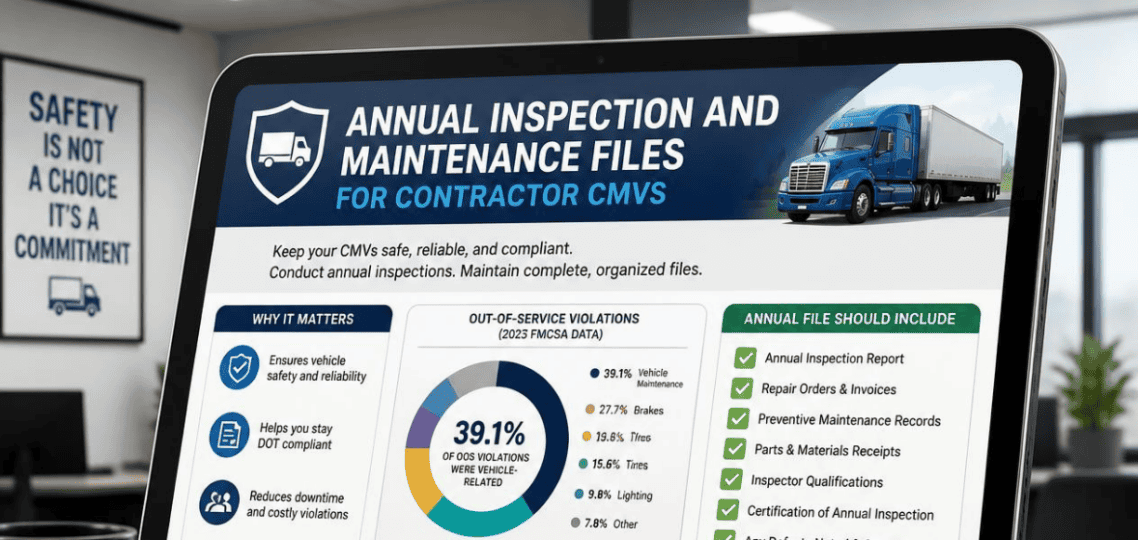
Annual Inspection and Maintenance Files for Contractor CMVs
Picture this. Your crew rolls a dump truck onto a job site. A DOT officer pulls it over on the way out. The first question isn’t about your load. It’s “Where’s your annual inspection report and vehicle maintenance records?” You dig through the glove box and find a faded sticker. That’s not enough. The truck gets parked. The clock stops on your project. And your safety score takes a hit you’ll feel for months.
Every day across the country, this situation plays out. Most contractors do not view themselves as trucking businesses. However, the moment you use a commercial motor vehicle, you must follow the federal regulations. This document simplifies the federal regulations related to annual inspections and the maintenance files. This document was designed for contractors that use trucks, trailers, and heavy equipment haul trucks. This document will answer the questions about annual inspection and maintenance files that you need to remain compliant.
What Counts as a Contractor CMV Under FMCSA?

A commercial motor vehicle, or CMV, isn’t just a semi-truck. Federal rules cast a wide net. A vehicle usually qualifies if it has a gross vehicle weight rating of 10,001 pounds or more. It also qualifies if it hauls certain amounts of hazardous materials or carries enough passengers.
That definition includes a lot of contractor equipment. Think dump, water, and service trucks. Consider crew trucks hauling loaded equipment trailers. Even a heavy-duty pickup may become an issue once pulling a trailer and a higher combined rating.
Here’s the rub. Many contractors believe that these rules only apply to long-haul freight carriers. Not necessarily. Cross a state line and the Feds become involved. Many states have also adopted these same rules for intrastate travel. So, that truck that rarely leaves the county could also be subjected to the same rules. When in doubt, assume your heavy trucks are regulated.
Why Contractor Vehicle Maintenance Records FMCSA Rules Matter
Recordkeeping is often seen as just another form of paperwork with no real-life consequences. Unfortunately, that isn’t the case. The Federal Motor Carrier Safety Administration (FMCSA) will enforce the law through roadside checks, compliance reviews, and full audits.
The statistics can be shocking. Around 22% of commercial vehicles inspected roadside are placed out of service due to roadside defects. There are undoubtedly issues that could be resolved through recordkeeping and documenting regular service. Violations of annual inspections are routinely among the leading inspection violation reports across the United States.
There is a financial burden as well. Civil penalties for serious violations can run well into five figures, and they are assessed per violation, so problems compound quickly across a fleet. Falsifying records carries its own exposure, including potential criminal liability. Poor vehicle maintenance scores impact the overall public safety profile and lead to poor insurance and client relations. There will be a noticeable impact to bid proposals. Just like other areas of contracting, recordkeeping for the maintenance of vehicles isn’t just more red tape; it is risk management for your business.
The Annual Periodic Inspection (49 CFR 396.17)
The heart of this topic is the annual periodic inspection. It lives in 49 CFR 396.17. The rule is simple to state. Every covered CMV must pass a thorough inspection at least once every 12 months. Proof of that inspection must be available.
One issue trips up contractors time after time. Each unit in a combination counts on its own. A tractor pulling a semitrailer and a full trailer requires three separate inspections, one for each unit. Add a converter dolly to that combination and it counts as its own unit too. The tractor’s inspection would not cover the trailer behind it. So if you run a truck and trailer, expect to produce a report for each of them.
Another myth that is commonly believed to be true is regarding the inspections that take place on the side of the road. Back in the day, satisfying the requirement for an annual inspection was possible if you had a clean roadside inspection. That is no longer the case. A roadside inspection with no violations will not suffice for your periodic inspection. A formal report is a must.
What the Annual Inspection Covers
The inspection is not a glance. It must cover, at minimum, every part and accessory listed in Appendix A to Part 396. That appendix spells out about 15 major component categories.
In practice, a qualified inspector checks the systems that keep a heavy vehicle safe on the road. That includes brakes, steering, and suspension. It includes lighting, wheels, and tires. It includes the fuel system, coupling devices, glass, mirrors, and the frame. The inspector functionally tests and measures these components. Then they document the result. A passing inspection means the vehicle met the federal minimum standard on that date.
Who Can Perform the Annual Inspection?
Periodic inspections have special consideration. The qualifications specific to 49 CFR 396.19 state that the inspection signatory must understand the relevant sections in Part 393 and Appendix A. In addition, the signatory must understand methods and tools to inspect as well as how to identify defective parts.
There are two ways to gain the necessary qualifications. Completion of a federal or state training program or a qualifying state certificate is one way. A person may also gain the qualifications through a minimum of one year of training and experience in maintenance of commercial motor vehicles (CMVs). That experience may be gained in a manufacturer program, fleet mechanics, or other similar occupations of a technical nature.
You may contract the inspection to a commercial garage, truck stop, or leasing company. The third party must have adequate facilities for the inspection and qualified personnel to inspect. Delegating the work does not delegate the liability. Under the rule, responsibility for ensuring the inspection is done and properly documented stays with you as the motor carrier, not with the shop you hired.
Many states have a useful time-saving provision. If your CMV passes a state program inspection that is recognized by the FMCSA as equivalent to a periodic inspection, that inspection fulfills the annual inspection requirement for twelve months. For those state inspections, you do not have to maintain records of the inspectors’ qualifications yourself. Do confirm that your state’s program is recognized as equivalent before relying on this provision.
What Goes Into a Compliant Maintenance File (49 CFR 396.3)
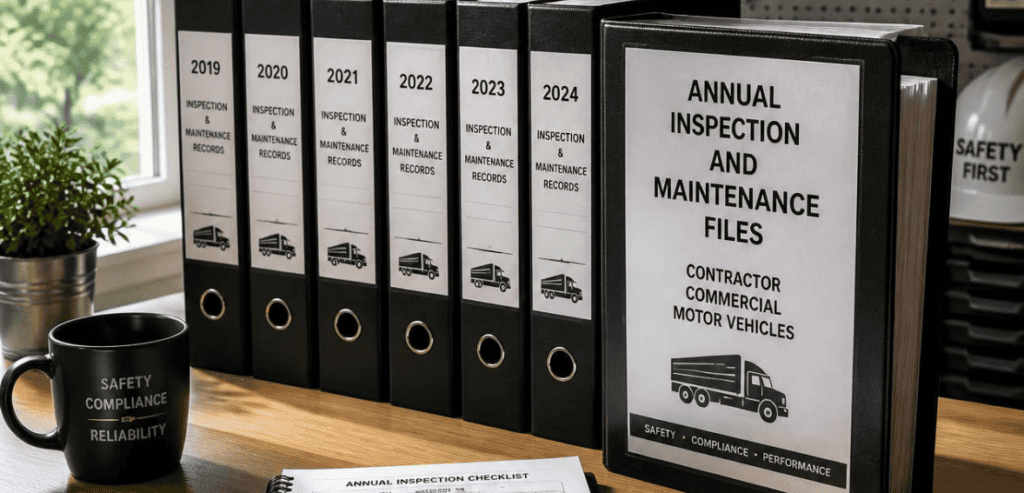
The annual inspection is one piece. The maintenance file is the bigger picture. Under 49 CFR 396.3, you must build and keep a file for every CMV you control for 30 or more consecutive days. That covers owned trucks. It also covers leased or rented equipment held longer than 30 days.
Each vehicle requires an independent file. You can’t have a shared box of mixed receipts. You will need a file for each vehicle with three main things. The first is identifying information. This is the vehicle make, the company or unit number, the serial number or VIN, model year, and the tire size. There can be no missing information. If you don’t include the tire size, you can be out of compliance.
The second document you need is a maintenance schedule. The maintenance schedule shows the inspections and services, including the dates they are due. This is the one document that most contractors forget to include and reviewers always look for the maintenance schedule. If you don’t include a maintenance schedule, you will be cited even if you performed maintenance on the schedule. A maintenance schedule can be in many formats. It can be a schedule, a service due date posted on a software dashboard, or even a calendar. The rule requires a system.
The third document is a running service history. This shows the history for each vehicle of events with the dates that services were performed, repairs were made, or inspections were completed. You will need to log the service and include the documentation. You will need to keep this log in a chronological format. This is the main document that shows your program is ongoing and real.
How Long to Keep Your Records

Retention rules confuse a lot of fleets. Different documents have different timelines. Getting this wrong is one of the most frequent audit findings.
We will begin with the maintenance file. In the industry, this is known as the “one and six” rule. You must keep active vehicle records for the year at the location the vehicle is kept. Afterwards, the records must be kept for six additional months after the vehicle has left your fleet via sale, trade, or scrap. Records for vehicles that are no longer in your possession can still cause a critical violation if the records are unaccounted for.
The annual periodic inspection report has its own retention schedule and must be kept for 14 months after the date of inspection. This extra time encompasses the following inspection cycle. Driver daily vehicle inspection reports must be kept for 3 months. Inspector qualification documents must be kept for one year after the inspector has ceased to conduct inspections.
One last thing to note, do not rely on the inspection sticker. Keeping only the inspection sticker on the door is a violation. Auditors expect the reports.
Paper vs. Electronic Records
You can keep these files on paper. But most growing contractors move to digital systems. FMCSA permits electronic recordkeeping. The records just have to be accurate, accessible, and ready to produce on demand during an audit.
Digital files solve real problems. Paper gets lost, coffee-stained, and buried. A cloud system keeps every vehicle’s history searchable in one place. It can flag due dates before they lapse. And it lets you export a clean packet the moment an auditor calls.
Fleetio
Fleetio is a good example of this type of software. Fleetio creates unique files for each vehicle. Fleetio associates the maintenance records, inspection reports, and scheduled preventive maintenance for the vehicle. Fleetio also notifies the user when the maintenance is due. Software like Fleetio helps users manage maintenance for their fleet and keep the maintenance history for users to reference. Fleetio and other software like it will not do your scheduling for you, but will help you keep service history records and defend your schedule. Whatever software you decide to use, make sure that it provides records in an inspector-approved format.
Common Mistakes Contractors Make
A few misunderstandings cause most compliance failures. The first is assuming newer equipment is exempt. It isn’t. A brand-new truck still needs its first annual inspection within the cycle.
The second example is regarding the consideration of the inspection of the tractor as an inspection for the trailer. Each unit stands alone. The third example is conflating a daily driver inspection with an annual periodic inspection. They are different by purpose and documented separately. A daily walk-around does not fulfill the annual requirement.
The fourth mistake is thinking that the maintenance taking place is the equivalent of compliance. If maintenance is not documented in the appropriate file in the appropriate level of detail, it essentially did not occur to an auditor. The most common reason for violations is missing or disorganized paperwork, not poor maintenance.
Building a System That Survives a DOT Audit
Routine is the basis of strong compliance, rather than luck. One person should oversee each aspect of your recordkeeping. Create a file for each vehicle the day it begins its service. Set calendar reminders for each inspection. Record each repair as it is completed.
Conduct a self-audit twice a year. Randomly select a few vehicle files to review. Each file should have the identification data, service history, and a current inspection report. Make the necessary corrections to any deficiencies before an officer does. You can read the specific regulation any time in the eCFR version of 49 CFR Part 396. If you need a more simplified version to quickly review what the regulation requires, the FMCSA safety planner is a good first step.
Conclusion
Annual inspections and maintenance files aren’t just legal boxes to tick. They protect your crews, your equipment, and your reputation. The rules are clear once you break them down. Inspect every covered CMV at least once a year using a qualified inspector. Keep a real file for each vehicle you control for 30 days or more. Track your due dates. Log your service. And hold onto the right records for the right amount of time.
Contractors who treat these files as a living system rarely fear an audit. Those who treat them as an afterthought pay for it in downtime, fines, and lost bids. Build the habit now. Your future self, standing at a roadside stop, will be glad you did.
Frequently Asked Questions
Do contractors really need annual inspections if they never leave the state?
Often, yes. Federal rules apply directly to interstate travel. But most states have adopted equivalent standards for intrastate operations. So a vehicle that stays local may still face the same annual inspection and maintenance file requirements. Confirm your state’s rules before assuming you’re exempt.
How long do I keep the annual inspection report?
You must retain the periodic inspection report for 14 months from the date of inspection. That’s separate from your general maintenance records, which follow the one-year-plus-six-months rule. Keep the full report, not just the sticker.
Can I do the annual inspection myself?
You can, if you meet the inspector qualification standards in 49 CFR 396.19. That means the right training or a year of relevant experience, plus the tools and knowledge to judge each component. Many contractors instead use a qualified commercial garage. Either way, you remain responsible for making sure it’s done and documented.
What happens if my maintenance file is incomplete during an audit?
Missing pieces are citable, even small ones like tire size or an absent maintenance schedule. Penalties for serious violations can exceed $15,000. Incomplete files also hurt your Vehicle Maintenance safety score, which affects insurance and future work. Complete, organized records are your best defense.