
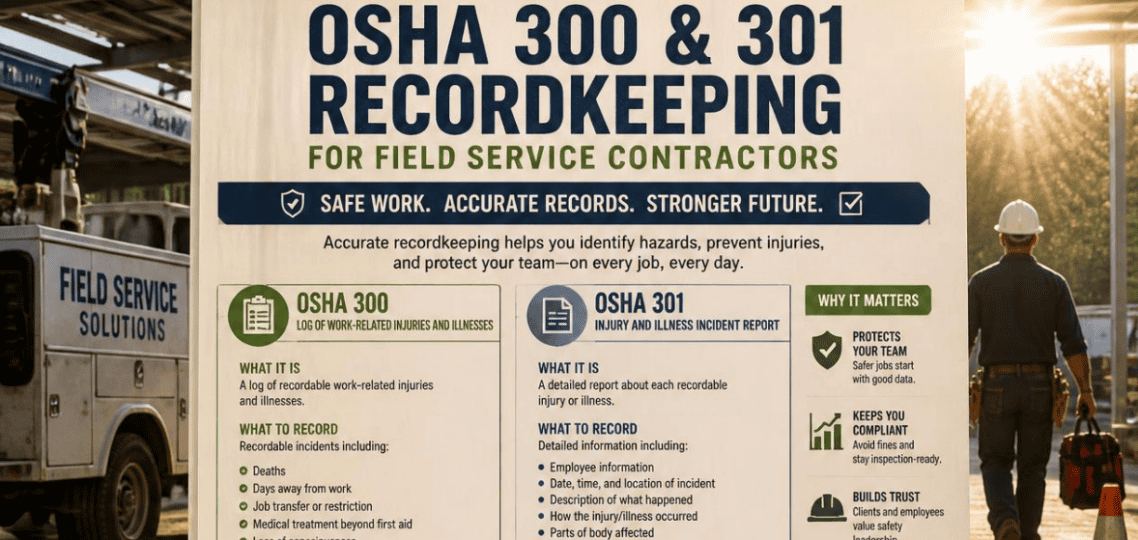
OSHA 300 and 301 Recordkeeping for Field Service Contractors
A technician falls while servicing an HVAC unit and plummets off a ladder. A crew member receives a chemical burn while cleaning industrial machinery. A lineman injures himself while straining while lifting a transformer. These unfortunate incidents are what differentiate compliant contractors from those who attract the attention of OSHA. If your field service company dispatches crews to contractor work sites, customer locations, or remote work locations on a daily basis, you understand that injuries occur in the field.
These in-field incidents are usually beyond the range of a company supervisor or manager. This distance creates the greatest amount of frustration and confusion about OSHA recordkeeping for most field service contractors. This guide explains the OSHA 300 and 301 forms, which contractors the forms apply to, and how to maintain forms in an audit-ready state while minimizing time and effort.
Why OSHA Recordkeeping Matters for Field Service Contractors
Field service work covers HVAC, electrical, plumbing, telecommunications, elevator maintenance, and similar trades where employees travel to different sites instead of clocking in at one fixed location. This mobile structure creates a recordkeeping challenge that office-based businesses rarely face. Injuries get reported late. Details get lost between the field and the front office. Supervisors sometimes never see the incident happen at all.
To solve this issue, OSHA introduced a recordkeeping rule found in 29 CFR Part 1904. In this regulation, OSHA requires employers to record work-related injuries and illnesses in a consistent manner and in a standardized format, regardless of the work location. In the case of field service contractors, accurate recordkeeping fulfills a federal requirement and can also reveal the presence of repeated hazards, such as strain injuries, falls, or other injuries associated with the use of ladders. Accurate recordkeeping can also help the business in the event of an OSHA inspection or a workers’ compensation claim, or in the event of a client’s safety audit.
Who Must Keep OSHA 300 and 301 Records
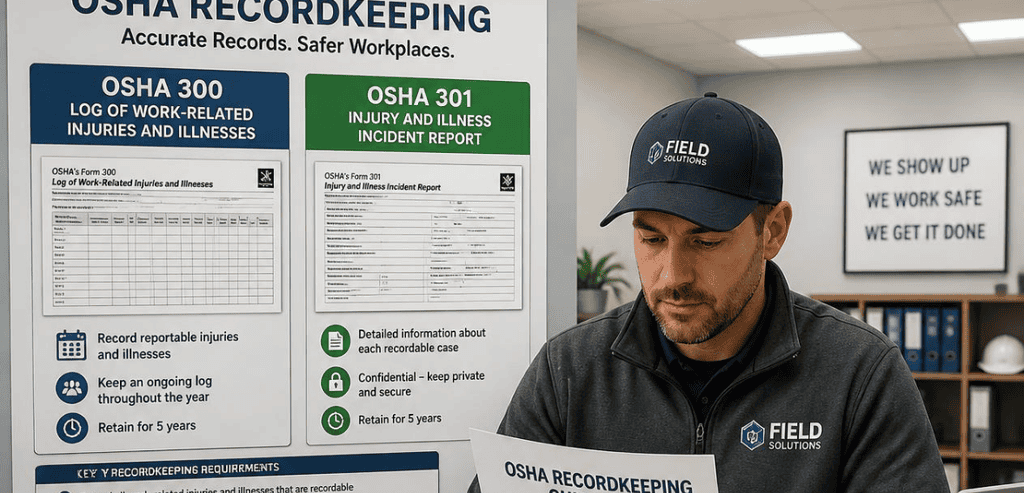
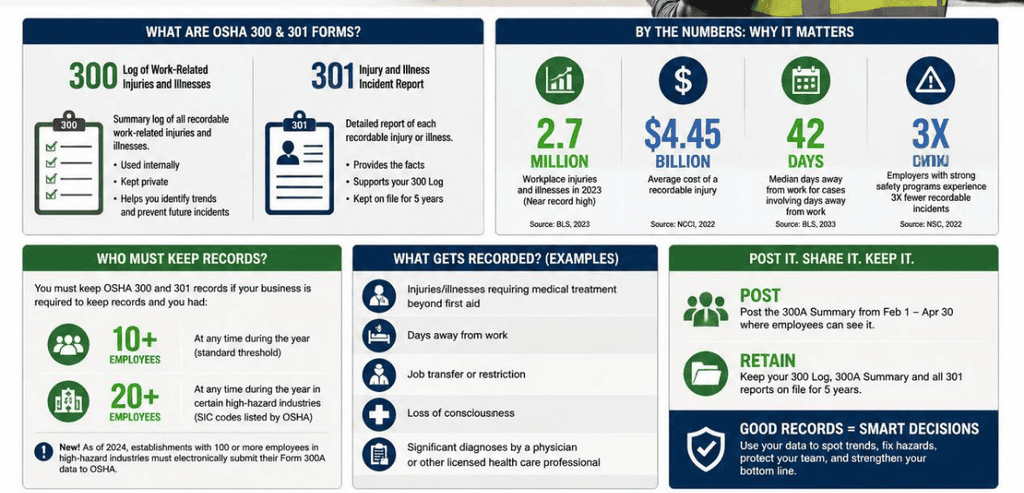
Recordkeeping obligations under Part 1904 generally apply to employers with more than ten employees at any point during the previous calendar year. Employers that had ten or fewer employees at all times during the last calendar year do not need to keep OSHA injury and illness records unless OSHA or the Bureau of Labor Statistics specifically informs them in writing that records are required. This size threshold catches many small field service operations off guard, especially seasonal contractors who scale their crews up during busy months.
Company size is not the only factor. Employers with over ten employees must keep OSHA records unless the business falls under a partially exempt NAICS code. Employers can reference the list of low-hazard industries in Appendix A to Subpart B of the Recordkeeping regulation to check for partial exemption. Most field service trades, including electrical, mechanical contracting, and general repair service, do not qualify for this exemption, since these services do not fall under low-hazard industries and do incur physical hazards.
Even businesses that qualify for size or industry exemption must report a serious incident. Employers that are exempt must still report workplace fatalities, in-patient hospitalizations, amputations, or loss of an eye to OSHA. That reporting duty is continuous no matter how small the employer.
Understanding the OSHA 300 Log Construction Contractors Rely On
The OSHA 300 log is the running record every covered employer keeps throughout the year. Each recordable injury or illness gets its own line entry, noting the employee’s job, the type of case, and whether the incident resulted in days away from work, restricted duty, or a job transfer. Construction and field service contractors tend to generate more entries here than office-based businesses because their crews face daily exposure to falls, electrical hazards, repetitive strain, and heavy equipment.
To defend against an OSHA 300 log audit, construction contractors must record incidents uniformly for all jobs, all crews, and all work sites. That includes work done far from the home office. A Texas dispatcher and an out-of-state technician are both required to submit incident reports to the primary OSHA 300 log. An OSHA 300 log maintained across dispersed, unintegrated regional paper logs or spreadsheets usually has significant omissions.
These omissions are typically discovered after OSHA requests five years of records. Centralized data systems, even informal ones such as a shared digital tracker, eliminate significant omissions and ensure log accuracy regardless of worksite location.
What Counts as a Recordable Injury
Determining what belongs on the 300 log comes down to a specific legal test, not a gut feeling about how serious an injury looks. An injury or illness meets the general recording criteria, and is therefore recordable, if it results in death, days away from work, restricted work or job transfer, medical treatment beyond first aid, or loss of consciousness. A twisted ankle that requires nothing more than rest and an ice pack does not need to appear on the log. A twisted ankle that keeps someone off a job site for two days does.
The definition of first aid, and when it is considered medical care, causes the most confusion, and for field service employers, this is a constant problem, as minor injuries like cuts, strains, and burns are the norm in the trades. OSHA has a closed, specific list of first aid treatments, such as taking non-prescription drugs at standard strength, cleansing and dressing minor injuries, and applying a bandage. All treatments that are beyond first aid, as defined by OSHA, are considered medical care for recordkeeping purposes, and the professional qualification of the person providing the care does not affect the classification.
This means that treatment at urgent care for a puncture wound would be considered first aid if it is on OSHA’s list, and an informal treatment by a coworker would be classified as medical care if it is beyond the list. Certain diagnoses and injuries automatically trigger a recordable case once a doctor confirms the diagnosis, such as a fractured bone, a punctured eardrum, cancer, or a chronic irreversible disease.
Completing OSHA Form 301 for Every Recordable Case
Every entry on the 300 log needs a matching, more detailed report on OSHA Form 301. This form captures the story behind the injury, including what the employee was doing right before the incident, what equipment was involved, and how the injury happened. For field service contractors, Form 301 is where site-specific details matter most, since an incident at a client’s facility often involves equipment, conditions, or hazards that the company’s own safety team never directly observed.
Here, timing is of the essence. An employer is required to complete the 300 log entry and the corresponding Form 301 within 7 calendar days of learning about the case. Field crew members who report injuries late, sometimes weeks after returning to the shop, put the company at risk of missing that seven-day window. The easiest way to avoid a citable violation is to build a habit of reporting incidents, even those that occur at a remote job site, on the same day or the following day.
The Role of Form 300A and Annual Posting Requirements
At the end of each calendar year, covered employers summarize their 300 log data on Form 300A. This summary totals the number of cases, days away from work, and job transfers or restrictions for the year, and a company executive must certify its accuracy. The completed 300A then gets posted in a visible location at each covered establishment, typically a break room or bulletin board, from February 1 through April 30 of the following year. For field service contractors with multiple branch locations, this means posting a separate 300A at each establishment rather than relying on one summary for the whole company.
Some employers also have an electronic submission requirement under OSHA’s Injury Tracking Application. OSHA requires establishments with 100 or more employees in designated high-hazard industries to electronically submit information from Form 300 and Form 301, while establishments with 20 to 249 employees in high-hazard industries must submit the Form 300A summary, both due by early March each year. OSHA is also collecting more of these submitted reports, which means the data carries greater exposure, since incomplete, inaccurate, or careless recordkeeping could be made public.
Retention, Access, and Multi-Location Considerations
All three forms, the 300 log, the 301 incident reports, and the 300A summary, must be retained for five years following the end of the calendar year they cover. That retention obligation carries over even if the business changes hands, so contractors going through a merger, acquisition, or ownership transition need to make sure records transfer along with everything else. Current employees, former employees, and their representatives also have a right to request these records, and OSHA generally expects a response by the end of the next business day.
There is an extra layer of complexity for field service businesses that conduct operations in more than one location, because each location is required to maintain its own records. A contractor with regional offices in three states will need a 300 log and a 300A posting for each of those states, even if the payroll and management functions occur at one corporate headquarters.
Creating a uniform process involving the same reporting form, the same timeline, and the same review procedures at every location will ensure consistency for the business and will make any OSHA inspection much less of a concern.
Practical Steps to Stay Compliant

A proactive approach to OSHA recordkeeping begins with training supervisors and dispatchers to identify recordable cases as soon as they are reported. This is much better than waiting weeks for someone in the safety office to make that call. Complement this training with an easy, mobile-friendly reporting process that allows field technicians to report an injury on the same day, regardless of the job site. Conduct quarterly log reviews instead of a single chaotic year-end review.
Don’t forget to cross-check your NAICS code and your employee counts, as a company that reaches ten or more employees, or a company that shifts into a higher-hazard industry classification, may take on new obligations. Consider the 300, 301, and 300A forms to be a workflow and a reporting process rather than three separate activities.
Conclusion
OSHA recordkeeping was built for a workplace where supervisors can watch what happens. Field service contractors operate in the opposite reality, with crews scattered across job sites and client locations every single day. That gap is exactly why the 300 log, Form 301, and Form 300A deserve real attention rather than a rushed once-a-year effort.
Getting the basics right — knowing who’s covered, understanding what counts as recordable, hitting the seven-day deadline, and keeping records for the full five years — protects your workers, your reputation, and your bottom line. A contractor with clean, consistent OSHA records walks into an inspection with confidence instead of dread, and that confidence is worth building now, before an incident forces the issue.
Frequently Asked Questions
Does a field service contractor with only nine employees need to keep an OSHA 300 log?
Generally, no. Employers with ten or fewer employees at all times during the previous calendar year are exempt from routine recordkeeping unless OSHA or the Bureau of Labor Statistics specifically requests records in writing. However, every employer, regardless of size, must still report a fatality, hospitalization, amputation, or loss of an eye.
What’s the difference between a recordable injury and a reportable injury?
A recordable injury goes on your OSHA 300 log because it meets criteria like days away from work or medical treatment beyond first aid. A reportable injury requires immediate notification to OSHA, typically within eight or twenty-four hours depending on severity. All reportable incidents are recordable, but not every recordable incident needs to be reported immediately.
How long do we need to keep OSHA 300, 301, and 300A forms?
All three forms must be retained for five years following the end of the calendar year they cover. This obligation continues even through an ownership change or business sale.
Do we need a separate OSHA 300 log for each job site our crews work at?
Recordkeeping requirements attach to each company establishment, such as a regional office or branch location, rather than to individual job sites. A field service contractor with several branch offices typically needs a separate log and posted 300A summary for each branch, even though technicians travel to many different client sites throughout the year.