
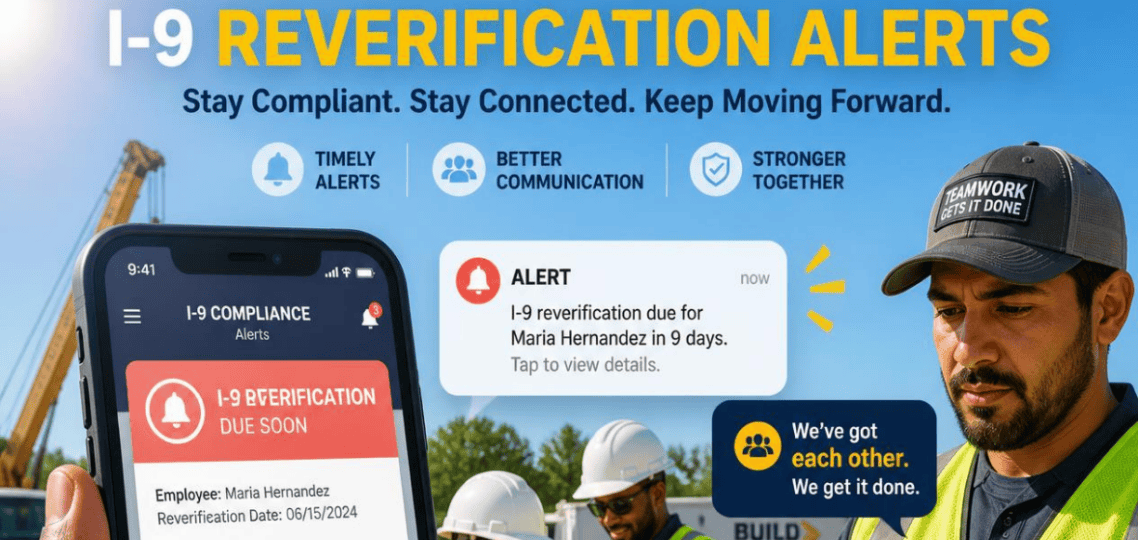
I-9 Reverification Alerts for Distributed Field Crews
Picture this. A crew lead is running a job site 300 miles from your head office. One of his best workers has a temporary work authorization that quietly expires on a Tuesday. Nobody flags it. The worker keeps clocking in. Three weeks later, an ICE Notice of Inspection lands on your desk. Now that missed date is not a small clerical slip. It is a substantive violation with a per-worker fine attached.
This describes a common situation in dealing with employment compliance when teams have to be out of the office. When your teams are working in different states, work sites, and living in different locations, the forms do not go with them. The forms get lost. This is when I-9 reverification alerts become important for field teams that are out in the field away from the office.
This manual explains I-9 reverification, the process of reverification for remote field teams, who it is for, and how you can make a system that creates alerts for you to be ready for an audit.
What I-9 Reverification Actually Means
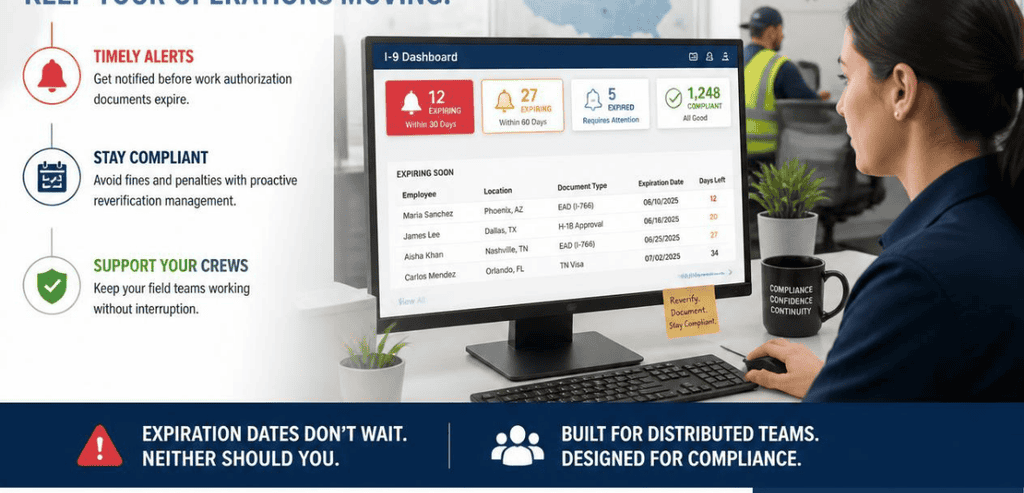
Every U.S. employer must complete Form I-9 to confirm a new hire’s identity and authorization to work. That part most teams handle fine. Reverification is the step they get wrong most often.
Reverification occurs when you need to re-confirm a current employee’s ability to work when their temporary work authorization expires. This does not require you to submit a new form. Instead, complete Supplement B, Reverification, and Rehire (formerly Section 3), and submit it with the employee’s original Form I-9.
We work with a simple trigger. A temporary employment authorization is about to lapse. Reverification must happen before this date. The employee presents an unexpired document from List A or List C that shows continued employment authorization. You record the document, and sign and date Supplement B.
Timing is important. Reverification must happen by the earliest of the employment authorization expiration date listed in Section 1 of the original Form I-9, the expiration date of the List A or List C document recorded in Section 2, or your corporate policy date. If you miss the deadline, the employee is not authorized to work with you, even if their status is valid in the background.
Why Distributed Field Crews Make Reverification Harder
Reverification is manageable when everyone sits under one roof. A single HR desk tracks the dates, and workers walk over with their documents. Field operations break that model in nearly every direction.
Your teams are spread out. A construction company, a landscaping business, or a utility subcontractor may have employees working at many different locations simultaneously. There isn’t a centralized office. Documents are crammed in glove compartments or binders and are never brought back to the office.
Turnover and seasonal hiring increase company churn. An employee can come to work for you for the summer, go, and come back the following summer, and each time will need to be brought into compliance again. Working across several states adds more complications because crews work across different legal jurisdictions and supervisors have to manage varying local regulatory frameworks.
And then there’s the paper problem. With I-9s kept in hard copy forms in a truck, there’s no one to manage or watch the expiration dates. When it’s finally brought to someone’s attention, the deadline has passed. For a workforce that’s spread out, dealing with the I-9 form on paper isn’t just a huge inconvenience. It is the biggest source of missed reverifications.
Who Needs Reverification, and Who Does Not
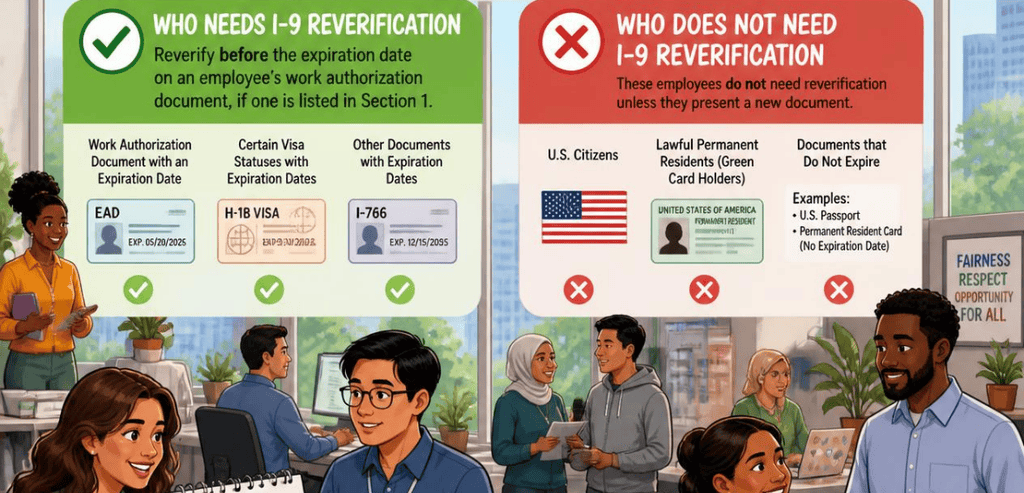
Before you build an alert system, you need to know which workers it should watch. Reverification is only required for employees whose employment authorization carries an expiration date.
U.S. citizens and noncitizen nationals do not need reverification as the status that allows them to work is not time constrained. Lawful permanent residents, including those whose lawful permanent resident status is evidenced by a green card, also do not need reverification, even those whose green cards have expired. The expiration of green cards does not indicate the expiration of the holders’ lawful permanent resident status.
List B documents are neither reverified nor are unrestricted Social Security cards or U.S. passports. Reverification of a worker who is not required to be reverified can cause a discriminatory effect; therefore, drafters of the rules are protected in both situations.
One more rule confuses most field managers. Reverification cannot be done by E-Verify. E-Verify is only allowed for the first time. When the authorization expires, the answer is Supplement B, not a new E-Verify case.
The Contractor Question: I-9 Reverification Tracking for Contractors
Field crews often blur the line between employees and contractors, so this deserves special attention. It is where I-9 reverification tracking for contractors gets genuinely confusing.
A true independent contractor does not complete an I-9 form. A true independent contractor is a 1099 worker, runs a business, and sets their own schedule. A true independent contractor gives you a W-9 instead. Because no I-9 is done, there is no re-verification.
The risk of using the term “contractor” does not end at the payroll counter. A lot of people that are called contractors are, in fact, employees. If you give someone a daily schedule, provide training, provide the equipment, and include them in your everyday work, that person is most likely a W-2 employee, no matter how you compensate them. Misclassification creates a misclassification violation and an I-9 issue at the same time.
Another source of risk is a staffing agency. When a staffing agency places employees on its own payroll, the staffing agency is the employer of record. The staffing agency has the I-9 and the obligation to reverify. However, you may still be at risk if you are heavily controlling those employees. The best way to protect yourself is to have a written agreement that clearly states the staffing agency has the I-9 obligation and you have the right to request documentation.
Even the most diligent teams can’t avoid this particular issue. ICE will almost always assume that all personnel present at your place of business are employees, and will require you to provide the I-9 Forms for each. This includes personnel you assumed to be contractors. As a reminder, ICE will consider a contractor to be an employee if they convert to an employee. You will need to provide an I-9 Form within three business days. This means that your system should track changes related to the classification of the contractors along with the expiration of the employment authorization. For the best understanding of verification requirements and the contractors, E-Verify guidance is the best source to refer to.
Building an I-9 Reverification Alert System That Works
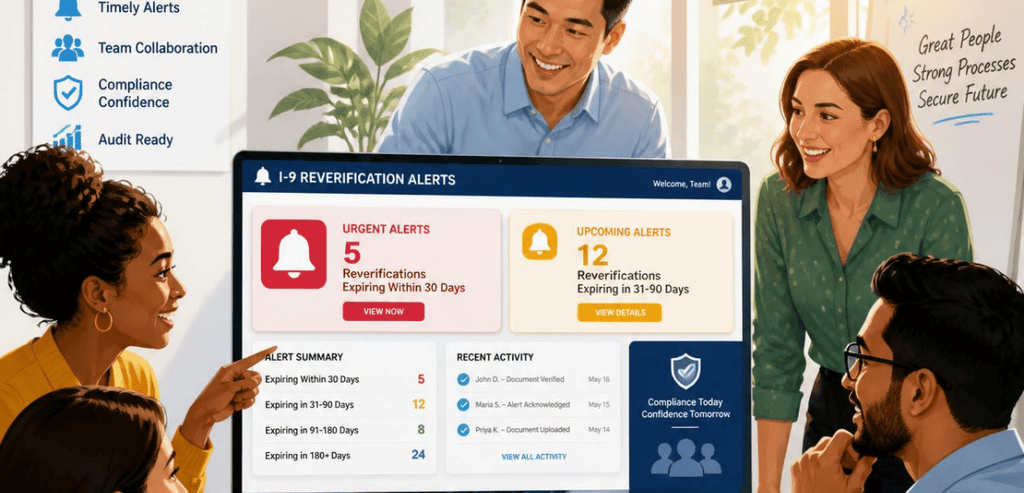
Now for the workflow. A reliable alert system is less about fancy technology and more about catching every date early enough to act. The federal best practice is to send the first reminder at least 90 days before reverification is due, then follow up at 60 and 30 days.
The 90-day window is not arbitrary. It accounts for the time needed to gather documents and the slow process of renewals with government agencies. A 30-day notice doesn’t account for delays, and any lapse in documents means the field worker legally cannot work for you.
Consolidate all expiration dates. Your tracker should cover the dates in both Section 1 and Section 2 as the earlier date prevails. Make sure there is accountability. Define whether a crew lead, regional coordinator, or central HR team will address each notification to ensure that the responsibility is taken.
Your field workers need mobility in your system since they won’t be at a stationary work desk. Your system must enable field workers to submit renewed documents via the system and allow a representative to complete the necessary paperwork remotely. Maintain a time-stamped record to ensure that you are protected during an ICE inspection.
Retention completes your document tracking cycle. Form I-9s must be maintained for 3 years after the hire date or one year after the employee has terminated, whichever date is later.
Tools That Automate I-9 Reverification Alerts
Manual tracking cannot scale across a distributed crew. Purpose-built software watches the dates for you and fires alerts automatically. A few platforms stand out for field and multi-site teams.
EMP Trust HR
EMP Trust has an automated reverification engine for tracking expiration dates. The engine sends alerts to HR and the employee when expiration dates are 90, 60, and 30 days away. The platform is ideal for distributed teams. It supports remote completion of Section 2 and connects with major HRIS and payroll systems, allowing employee data to automatically flow.
Tracker I-9 by Mitratech
Tracker I-9 integrates all I-9 management and E-Verify needs with audit tracking capabilities in the cloud. Tracker I-9 is excellent for employers with remote and distributed staff due to its extensive network for remote verifications. Tracker I-9 remote verification makes it possible for employers to book and conduct in-person Section 2 checks throughout the U.S. Supervisors in the field can sign Section 2, view reminders, and receive alerts all on their mobile devices. Supervisors can also document, capture, and send needed documents.
i9 Intelligence
i9 Intelligence targets distributed teams, seasonal hires, and multi-site operations directly. It automates the full I-9 lifecycle, from employee self-service through remote verification, E-Verify submission, and reverification tracking, and stores every form centrally so records stay easy to find across worksites. That centralized storage is a real advantage when your crews span several states.
Whichever platform you choose, the goal is the same. Move expiration dates off paper and into a system that alerts the right person early enough to act.
Penalties for Missing a Reverification Deadline
Mistakes here have expensive consequences. For example, a late reverification is not a typo that can be easily fixed. It will incur a fine that applies to every worker, and there will not be a grace period for this fine.
According to the adjusted DHS fine schedule, civil penalties for the knowing employment or continued employment of an unauthorized worker will cost anywhere from about $716 to $28,619, again, per worker, with first offenses at the low end of that range and third or later offenses at the top. Those fines can easily skyrocket to over a hundred thousand dollars with large crews of workers. Compare that potential loss to the relatively small cost of implementing an alert system.
Conclusion
Reverification is not complicated in theory. The hard part is never the rule. It is catching the date in time when your people are spread across job sites, states, and seasons. For distributed field crews, a missed expiration is the easiest compliance failure to commit and one of the most expensive to pay for.
The fix is a disciplined workflow backed by early alerts. Track every expiration date from both sections of the I-9, warn the right owner at 90, 60, and 30 days, verify only the workers who actually need it, and keep a clean audit trail. Watch your contractor classifications just as carefully, because the label you use will not protect you in an audit. Do that consistently, and reverification stops being a landmine and becomes a routine you barely notice.
Frequently Asked Questions
When exactly do I have to reverify a field worker’s I-9?
You must reverify by the earlier of two dates: the employment authorization expiration date in Section 1 of the original I-9, or the expiration date of the List A or List C document in Section 2. When those dates differ, act on the earlier one. Best practice is to start the process 90 days ahead so the worker has time to renew.
Do independent contractors on my crew need I-9 reverification?
True 1099 independent contractors do not complete a Form I-9, so there is nothing to reverify. The catch is misclassification. If you control their schedule, tools, and daily work, they may legally be employees who do need an I-9. And during an audit, ICE often treats everyone on site as an employee, so track classification closely.
Can I use E-Verify to reverify an expiring work authorization?
No. E-Verify is only for initial new hires. When a worker’s authorization expires, you handle it on Supplement B of Form I-9, not through a new E-Verify case.
What happens if I miss a reverification deadline?
The worker is no longer authorized to work for you as of the expiration date, even if their status is valid in the background. Continuing to employ them is a substantive violation that can bring civil penalties ranging from roughly $716 to $28,619 per worker, with repeat offenses falling at the top of that range.