
Effective Team Communication in Field Service: Tools and Tips for the Office & Field
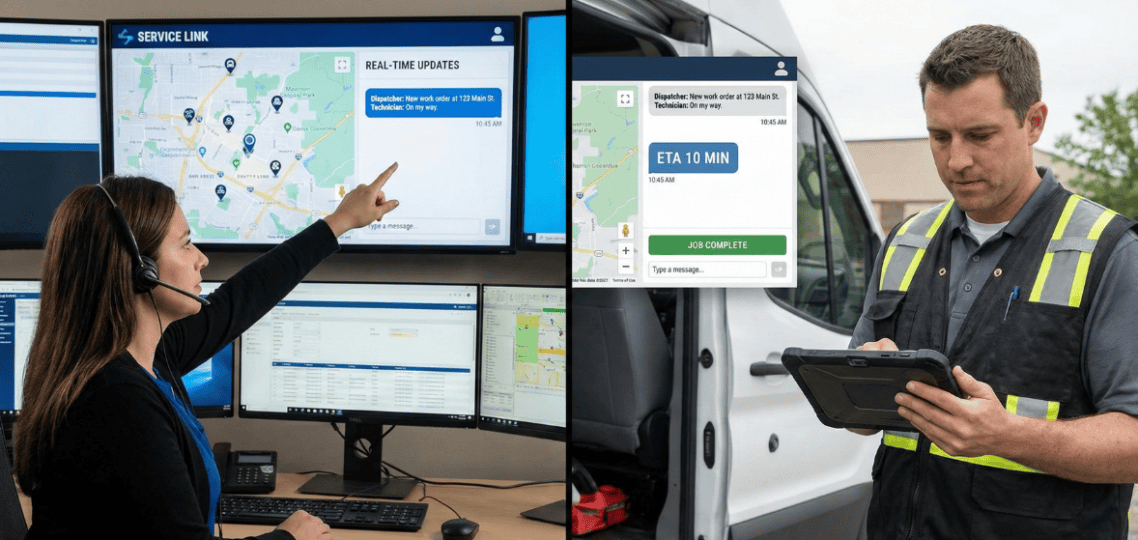
Communication is the backbone of every successful field service operation. When the office, dispatchers, and field technicians are aligned, jobs move smoothly, customers stay informed, and productivity rises. But when communication breaks down even for a moment the consequences can be expensive: wasted travel time, incorrect parts brought to the job, duplicated efforts, unhappy customers, or even safety risks. For many service businesses, improving internal communication delivers a bigger performance boost than adding more staff or equipment. That’s why understanding modern communication methods and best practices is critical for any team that wants to operate efficiently and deliver exceptional service.
Today’s service businesses operate in an environment where customers expect instant updates, technicians juggle multiple jobs daily, and office teams manage constant scheduling changes. Traditional forms of communication like handwritten notes, sticky reminders, scattered text messages, and long call chains can’t keep up. Modern communication is about clarity, accountability, and real-time information flow ensuring the right message gets to the right person at the right moment. The companies performing at the highest level treat communication not as a casual task but as an operational discipline supported by technology, structure, and culture.
Why Communication Breakdowns Hurt Field Service Performance
Poor communication in field service isn’t just inconvenient; it directly impacts revenue, efficiency, and reputation. When technicians don’t receive accurate job details or updates, they might arrive unprepared, wasting time and causing delays. If dispatch is unable to share urgent schedule changes quickly, jobs can run behind, causing a ripple effect throughout the day. Inaccurate notes passed between the office and the field can even lead to costly rework or to technicians bringing the wrong tools and parts.
Miscommunication doesn’t just affect operational efficiency it affects customer trust. A customer who waits for hours without updates or receives mismatched information from different team members is far less likely to become a repeat client. And if delays occur because the team isn’t coordinated, the customer rarely cares who dropped the ball they blame the business as a whole. Over time, even small communication failures can erode credibility and increase churn.
On the flip side, when communication flows seamlessly, technicians arrive confident, customers feel informed, and the office team has complete visibility into what’s happening throughout the day. The difference between chaos and order is rarely more staffing, it’s better communication.
Common Communication Challenges Field Teams Face

Field service environments naturally present unique communication challenges. Unlike office-based teams, technicians are constantly mobile, working at various locations and often with unpredictable schedules. They might be driving, on ladders, in basements, or dealing with equipment noise, all circumstances that make real-time phone calls unreliable. Many businesses historically relied on verbal instructions relayed quickly between jobs, but small details can easily be forgotten or distorted. Even something as simple as a missing serial number, wrong address spelling, or inaccurate equipment description can cost a full day of productivity.
Another challenge arises when information is scattered across multiple channels. Technicians may receive instructions by SMS, WhatsApp, email, or phone. When information lives in different places, messages get buried, forgotten, or misinterpreted. Without a single source of truth, efficiency suffers. The office team may believe a message has been communicated, while the technician never actually receives it.
Also, when communication depends on one or two people often the dispatcher or lead technician bottlenecks form. If that person is unavailable for a moment, the entire workflow pauses. A strong communication system removes dependency on individuals and instead establishes consistent processes and shared platforms.
Modern Communication Tools Transforming Field Operations
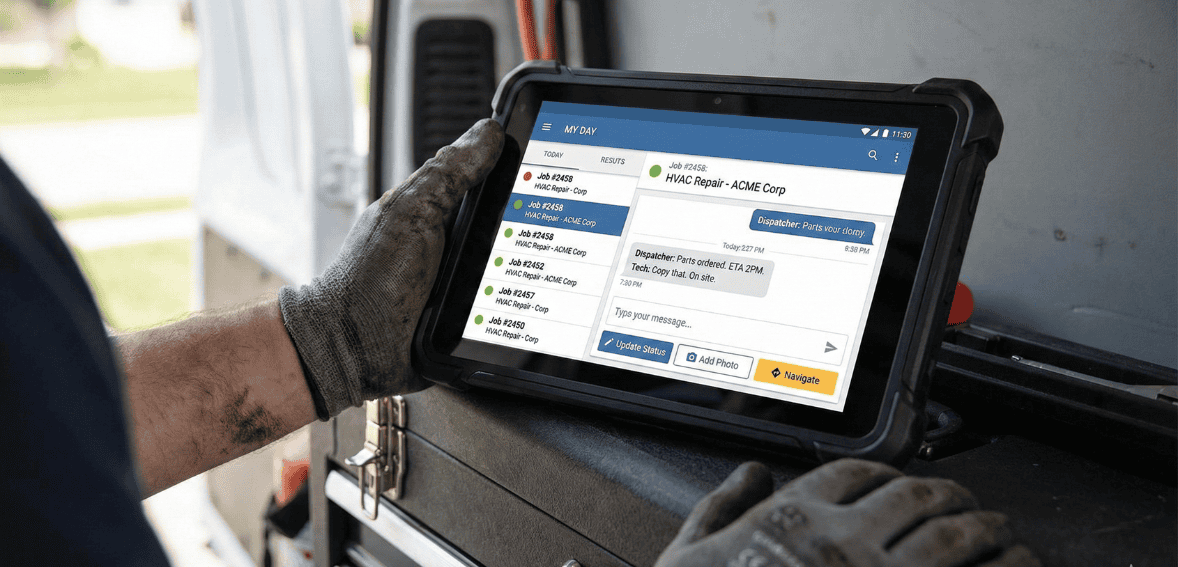
Field service communication has evolved far beyond clipboards and voicemail. Today, the most efficient service companies rely on unified mobile communication platforms designed specifically for field workflows. Instead of relying on open-ended conversations that are easily forgotten, modern communication tools deliver structured, documented, and instantly accessible information.
Real-time messaging features built into field service management platforms enable technicians and office staff to communicate within job records, ensuring that all notes, images, and updates are tied directly to the work order. Job status changes such as arrival, completion, or follow-up requirements can be logged with a single tap, automatically updating dispatch and reducing the need for phone calls. Push notifications ensure that schedule changes or urgent updates reach technicians immediately, regardless of their location.
Using visual communication is another significant advancement. Photos shared directly from the job site give context that words can’t always capture. Instead of describing a damaged component verbally, a technician can send a picture and receive guidance in seconds, saving unnecessary trips. This visual documentation also supports quality control and protects against disputes.
Creating Communication Protocols and Expectations
Technology alone cannot fix communication issues unless the team follows consistent practices. Successful field service businesses establish clear expectations for when and how communication happens, rather than relying on improvisation. Protocols include rules such as checking the communication app after every job, confirming receipt of new job assignments, or documenting all customer notes within the job record rather than in personal messages.
Structured habits eliminate guesswork. For example, a simple standard like “Technicians must send a status update when leaving each job” allows dispatch to assign the next job accurately and notify customers of the timing. Likewise, establishing guidelines for escalation that requires a phone call versus an in-app message keeps urgency aligned with channels. Some companies implement short morning check-ins to review priorities, while others hold end-of-week debriefs to address recurring communication breakdowns. The most successful teams treat communication as a skill that requires learning, routine, and consistency.
The Role of Real Time Visibility in Communication
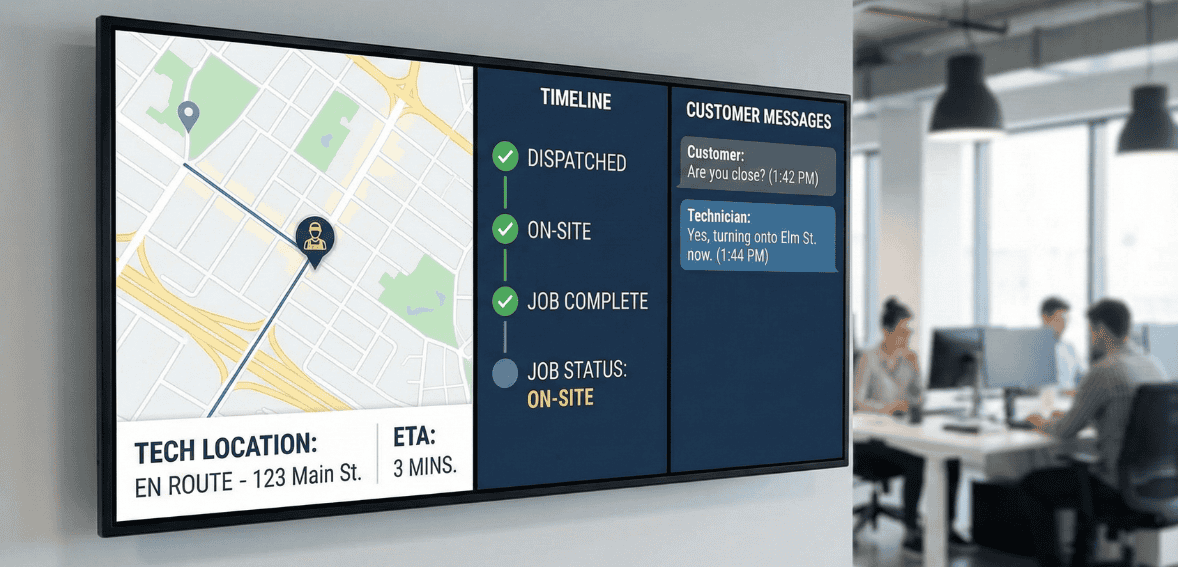
Transparent communication goes beyond messaging; it’s about visibility. When office staff can see job progress in real time, they can respond proactively rather than reactively. Being able to track technician status, location, and job timelines allows dispatchers to optimize scheduling, provide accurate updates to customers, and better adapt when emergencies arise. Without visibility, decisions rely on guessing.
For technicians, real-time visibility provides clarity and confidence. They can see upcoming jobs, required equipment, notes from previous visits, and safety instructions all without having to call in for clarification. That means less time waiting for answers and more time focused on actual work. Real-time visibility isn’t simply a convenience, it’s the foundation for reducing delays and eliminating misunderstandings.
Building a Culture of Open and Respectful Communication
Tools and structure work best when supported by a positive communication culture. When field and office teams operate with mutual respect, transparency, and shared goals, communication becomes easier and more natural. Teams that encourage honest conversation without blame improve faster and stay stronger. If technicians feel comfortable asking questions or admitting confusion, mistakes are caught early. If the office respects the realities of fieldwork, instructions become more straightforward and practical.
Recognition also plays a role. Celebrating excellent communication like a technician who consistently submits thorough job notes or a dispatcher who anticipates needs reinforces good habits. Trust becomes a competitive advantage, and communication becomes a strength instead of a struggle.
Improving Communication with Customers Through Internal Alignment

Strong internal communication naturally results in better external communication. When the office and field teams communicate clearly, the customer receives consistent, accurate information at every step. Different people are telling one of the most common frustrations customers experience different things. For example, the scheduling office says the technician will arrive at 10 AM, while the technician says 10 AM. Still, the technician shows up at noon with no notice. The customer isn’t angry about the delay itself; they’re angry about the silence. But when communication flows smoothly across the team, customer updates become timely, transparent, and reassuring.
Clear internal communication with customers also empowers dispatchers to update customers confidently. When they know precisely where a technician is, what job they just completed, and whether unexpected issues have affected timing, customers don’t sit in uncertainty. Communication tools that enable real-time job status updates make customer notifications effortless, allowing the business to send quick messages like, “Your technician is finishing the previous job and should arrive around 11:20 AM.” These small touches dramatically change how customers perceive the company they feel informed, respected, and involved.
In service industries, customers judge the experience as much as the work itself. A perfectly executed repair can feel disappointing if the communication leading up to it was stressful. On the other hand, even a delayed job can still end with a five-star review if the customer feels guided, updated, and understood. That’s why communication isn’t an internal matter only it’s a direct contributor to customer satisfaction, loyalty, and repeat business.
The Role of Documentation in Consistent Communication

Field service communication relies heavily on documentation. Memories fade, details get lost, and verbal instructions don’t always travel accurately between teams. Documenting job notes, customer requests, parts used, safety requirements, and follow-up needs ensures that nothing critical depends on recollection or chance. Documentation also protects the business and the customer. If there is ever confusion about what was said or agreed to, written notes provide clarity rather than create conflict.
For technicians, documentation also becomes an essential support tool. When they arrive at a job they’ve never worked on before, detailed notes from previous visits can prevent repeat work, avoid mistakes, and save time. For example, knowing that a particular appliance always requires a specific adapter or that the customer’s dog must be secured before entry are small but powerful details that make a big difference. When documentation is standardized and consistently shared, the entire operation becomes more efficient.
Thorough documentation also contributes to training and performance improvement. By reviewing notes and communication records, managers can identify recurring challenges, common miscommunications, or missing process steps. Everything becomes more transparent and more measurable, enabling better coaching and smoother collaboration.
Using Technology to Bridge Distance and Strengthen Team Connection

Field teams often feel disconnected from the office or from each other simply because they don’t physically share space. Unlike office teams that chat across desks, field technicians spend most of their day alone in trucks or in customer homes. Without intentional communication systems, they can feel isolated, unsupported, or out of the loop on important updates.
Technology plays a significant role in making remote workers feel connected. Group announcements, shared discussion channels, weekly video check-ins, or even informal message threads can build a sense of community. When teams openly share successes, challenges, and appreciation, morale increases. A technician who knows the office is watching out for them and values their work is more confident in the field. And when the field team feels included in decisions rather than simply receiving instructions, collaboration strengthens.
Communication tools that enable photo sharing, quick questions, and peer support also reduce stress. Instead of stopping a job because they are unsure about something, technicians can instantly ask the office or another team member for help. This transforms a potentially stressful moment into a collaborative solution, preventing delays for the customer.
Reducing Stress and Preventing Burnout Through Clear Communication
Poor communication increases anxiety people worry about missing updates, unclear expectations, or unaddressed problems. When communication is reliable, predictable, and documented, stress levels decrease dramatically. Technicians feel confident knowing they always have access to job details and that support is available when needed. Dispatchers feel less overwhelmed because they aren’t constantly fielding calls for status updates or to clarify instructions. Managers feel more in control because they can see what’s happening without micromanaging.
Clear communication also prevents a blame culture. Instead of arguing over who forgot to pass on a message, everyone can refer to the recorded communication. Accountability becomes a shared responsibility rather than a finger-pointing battle. When stress decreases, job satisfaction increases and retention improves. That matters because keeping experienced technicians is far more valuable than constantly hiring and training new ones.
Training Teams to Communicate Effectively

Communication isn’t just about tools, it’s a skill. Even with the best technology, team members need to learn how to communicate clearly, respectfully, and proactively. Training should emphasize clarity, brevity, politeness, and accuracy. Teams should be encouraged to think before sending messages, to provide enough detail to prevent confusion, and to confirm when needed.
Training also helps standardize expectations. When communication habits vary widely between technicians, the result is inconsistency. But when everyone operates with shared practices such as updating job status immediately, documenting essential details, and responding to messages promptly the workflow becomes smooth and predictable.
Practical communication training also includes emotional intelligence. How team members speak to one another shapes culture. Encouraging patience, respect, and supportive language builds trust and a sense of belonging, even under pressure. When people feel valued, they communicate better and the organization benefits.
Conclusion
Effective communication is one of the most potent tools a field service business can invest in. It shapes productivity, customer relationships, scheduling accuracy, efficiency, and team culture. When communication is fragmented or inconsistent, problems multiply, and frustration grows. But when communication is unified, structured, and supported by technology, operations run smoothly and predictably. Technicians feel supported, dispatchers feel confident, and customers feel informed and respected.
Today, communication isn’t just about exchanging information, it’s about keeping people connected, aligned, and empowered. Businesses that prioritize communication as a strategic asset rather than an afterthought position themselves for sustainable efficiency, higher service quality, and stronger customer loyalty. A field service operation that communicates well succeeds.
FAQs
How can field service teams improve communication without adding more staff?
By centralizing communication in a single platform and establishing consistent protocols, teams can significantly reduce confusion and duplicate conversations. Real-time messaging, job-tied notes, and status updates eliminate the need for constant phone calls and improve visibility for everyone.
What is the most reliable way to update technicians about schedule changes?
The most effective method is instant digital notifications tied directly to the job record. This ensures information is delivered quickly, clearly, and with written confirmation, rather than relying on phone calls that may be missed while driving or working.
How does good internal communication benefit customers?
Customers feel more confident and valued when they receive timely updates, accurate ETAs, and consistent information across the team. Transparent communication improves trust and increases satisfaction, making customers far more likely to return and recommend the business.
What role does documentation play in field service communication?
Documentation creates accuracy and accountability. When job notes, photos, and updates are recorded, technicians arrive prepared, misunderstandings decrease, and follow-up work becomes easier and more reliable.
How can communication tools improve safety?
Safety procedures and compliance instructions attached directly to job records ensure technicians have the critical information they need before work begins. Clear communication about risks and requirements reduces accidents and reinforces a safety-first culture.