

Data-Driven Decisions: Using Field Service Analytics from Job Management Software
Running a field service business today is no longer about instinct alone. While experience still matters, decisions based purely on gut feeling often lead to inefficiencies, missed opportunities, and avoidable costs. Modern service operations generate enormous amounts of data every single day, from job completion times and technician productivity to customer response patterns and revenue per visit. The difference between average and high-performing service businesses increasingly comes down to how well this data is used.
Field service analytics gives a competitive edge. Job management software does more than organize schedules and invoices. It quietly collects valuable operational data. Analyzed correctly, this data enables data-driven decisions. These decisions improve efficiency, increase profits, and strengthen customer satisfaction. Instead of guessing about slipping profits or overwhelmed technicians, leaders see the reality and act with confidence.
To understand the power of data in service businesses, this article explores how analytics from job management software supports smarter, faster, and more accurate decision-making across field service operations. Key takeaways include which metrics matter most, how to interpret them, and practical steps for turning raw numbers into meaningful actions that drive long-term business success.
Field Service Analytics as the Foundation of Modern Operations

Field service analytics is the process of collecting, measuring, and interpreting data generated by daily service activities. Every dispatched job, completed task, invoice sent, and customer interaction produces data points that reveal how efficiently the business operates. When aggregated and analyzed, these data points provide a clear picture of performance trends that would otherwise remain invisible.
Historically, many service companies relied on spreadsheets or manual reporting, which limited visibility and often resulted in outdated insights. Today, job management platforms automatically centralize this information. Dispatch records show technician movement and response times. Work orders capture job duration and the success of the resolution. Financial modules track revenue per job and payment timelines. Together, these inputs form the backbone of field service management software.
Consistency brings real power. Analytics tools do not rely on memory or stories. They record actual events across hundreds or thousands of jobs. Over time, clear patterns emerge. These patterns show why certain technicians excel, why some routes cost more, and why specific services bring higher margins. Such insights help businesses move from reactive fixes to proactive improvements.
Why Data-Driven Field Service Outperforms Guesswork
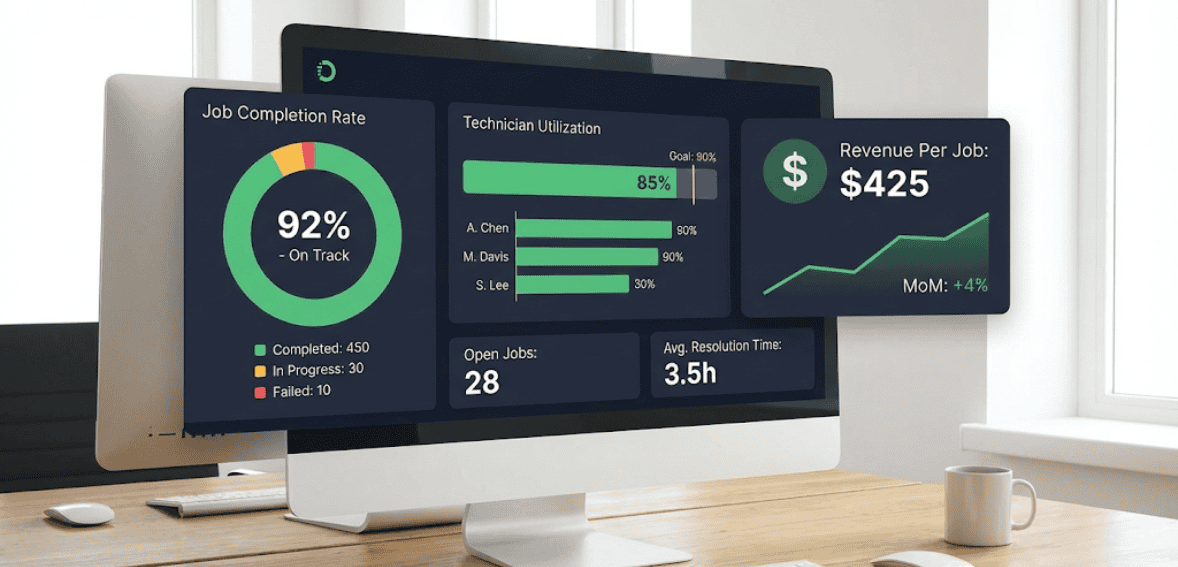
Many service businesses don’t fail for lack of effort, but for lack of clarity. Without analytics, managers assume, without proof, that technicians are working at capacity, marketing is working, or pricing is competitive. Data-driven field service uses facts, not assumptions.
For example, analytics may reveal that technicians spend much of their day driving rather than completing jobs. Certain appointment windows may lead to more cancellations. A specific service may earn strong revenue but suffer from low first-time fix rates. With these insights, leaders can make targeted changes instead of broad, disruptive ones.
Data-driven decisions create accountability. Transparent performance metrics clarify expectations. Dispatchers see how their schedules affect productivity. Technicians understand how efficiency impacts results. Leadership can check if changes actually improve performance or simply shift the problem.
Most importantly, analytics lets businesses grow with control. Unmeasured growth leads to chaos; analytics-based growth allows for smart, informed expansion.
Turning Job Data Into Actionable Intelligence
Raw data alone does nothing. Interpretation creates value. Job management software turns logs into reports that answer vital questions: Where do we lose time? Which services earn the most? Which customers need more resources?
Job performance metrics are particularly useful in identifying inefficiencies. Completion time, return visits, and on-site labor hours highlight how effectively work is executed. When consistently reviewed, these metrics indicate whether delays stem from poor scheduling, insufficient training, missing parts, or inaccurate job estimates.
Similarly, analytics helps uncover operational bottlenecks. A pattern of late starts may point to dispatch issues or unclear work orders. Frequent rescheduling might indicate unrealistic appointment windows. High overtime costs could signal understaffing or inefficiencies in the routing. By visualizing these patterns, managers can confidently prioritize improvements.
Analytics drives continuous improvement, not just one-time fixes. Trends shift over time. Regular review keeps improvements in place and spots new issues fast, before they hit customers or revenue.
Service Business KPIs That Actually Matter
Not all metrics matter. The best KPIs focus on profitability, efficiency, and customer experience. Field service analytics software helps you highlight useful data and avoid information overload.
Operational KPIs such as job completion rate, first-time fix rate, and average job duration reflect service quality and technician effectiveness. Financial KPIs like revenue per job, invoice aging, and cost per service highlight profitability and cash flow health. Customer-related KPIs, including satisfaction scores, repeat service frequency, and response time, reveal how service delivery affects long-term loyalty.
Alignment is key. KPIs should support strategic goals. A business focused on growth may watch customer acquisition efficiency and technician use. One focused on margins may emphasize labor costs and pricing accuracy. Analytics tools help leaders customize dashboards to show the metrics relevant to their goals.
When KPIs are reviewed consistently, not just during crises, they become early warning systems. Small performance declines can be addressed before they become systemic problems.
Using Analytics to Improve Scheduling and Dispatch Decisions
Scheduling is a key area where analytics brings improvement. Poor scheduling wastes time, causes missed appointments, and frustrates technicians. Field service analytics shows how scheduling decisions affect real-world outcomes.
Dispatch data shows time spent traveling, how often schedules shift, and how estimates match reality. Patterns appear over time that guide better scheduling. Some services may always take longer than planned. Certain areas may need buffer time. Some technicians may excel at specific jobs.
Using analytics reduces scheduling guesswork. Routes become more efficient. Technicians arrive on time more often. Emergency calls cause less disruption. These daily improvements lead to higher completion rates without increasing labor hours.
Analytics lets you test and refine scheduling changes based on results, not guesswork.
Financial Visibility Through Field Service Analytics
Financial decisions improve when analytics connect operational data and revenue. Job management software links labor time, material use, and billing into a single set of reports. These reveal true job profitability.
Without analytics, businesses may assume that certain services are profitable based solely on invoice totals. In reality, labor overruns, travel costs, or repeated visits may erode margins. Field service analytics software exposes these hidden costs, allowing pricing strategies to be adjusted accordingly.
Cash flow analytics are also important. Invoicing timelines, payment delays, and outstanding balances reveal financial health. Businesses see which customers pay late, which services generate fast payments, and which billing steps slow down revenue.
This transparency supports better pricing, staffing, and investment decisions. Leaders know growth is based on facts, not hope.
From Reporting to Strategic Decision-Making
The true value of analytics is strategic use. Reports should not just be for record-keeping. They must spark conversations and guide daily actions.
When leadership reviews analytics together, decisions become fact-based rather than opinion-based. When frontline staff see their impact in the numbers, they get more engaged. Transparency builds trust and alignment.
Analytics helps service businesses move quickly. You see opportunities sooner and fix problems faster. Growth becomes a choice, not a reaction.
Advanced FSM Reporting: Turning Data Into Clear Business Signals
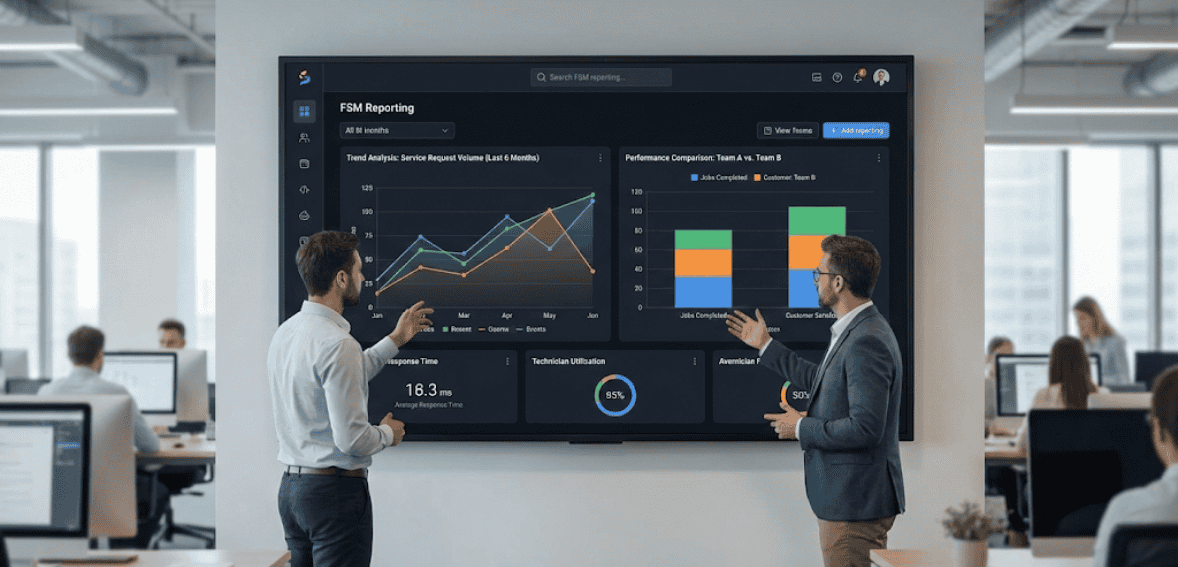
As field service operations mature, basic reports are no longer enough. Leaders need reporting that doesn’t just describe what happened, but explains why it happened and what to do next. This is where advanced FSM reporting becomes critical. Modern job management software organizes data into visual dashboards that surface trends instead of isolated numbers.
Advanced reports allow managers to compare performance across time periods, service categories, regions, and technicians. For example, instead of simply seeing total jobs completed last month, leadership can evaluate which job types consumed the most labor hours, which generated the highest revenue per visit, and which experienced the most follow-up calls. This layered visibility turns raw data into actionable insight.
Another advantage of advanced reporting is consistency. When reports update automatically, decisions are made using the same definitions and data sources across departments. Dispatch, finance, and operations all work from a shared understanding of performance, reducing confusion and misalignment. Over time, this consistency creates confidence in decision-making and improves accountability at every level of the organization.
Using Field Service Analytics to Predict Outcomes, Not Just Review History
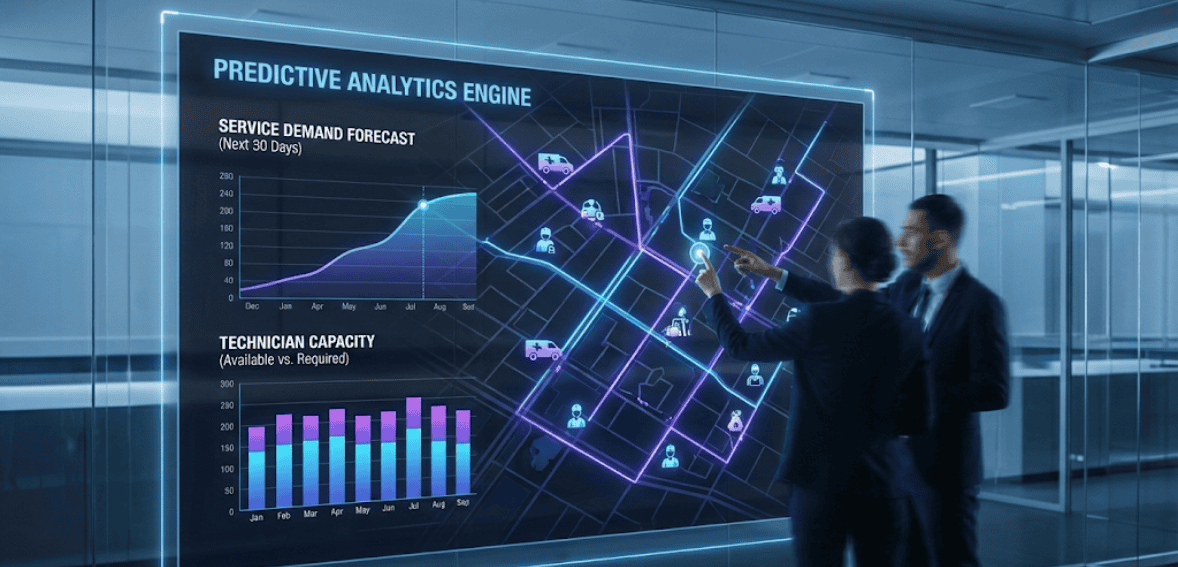
One of the most powerful benefits of field service analytics software is its ability to support forward-looking decisions. Historical data becomes a foundation for prediction. When patterns repeat consistently, businesses can anticipate outcomes before they occur.
For instance, analytics may show that certain services experience higher cancellation rates during specific seasons or time windows. Armed with this insight, managers can proactively adjust scheduling buffers or confirmation workflows. Similarly, patterns in technician performance can reveal which skills lead to faster resolution or fewer callbacks, informing training priorities and hiring decisions.
Predictive analytics also plays a role in capacity planning. By analyzing historical job volumes, response times, and technician availability, leaders can forecast staffing needs more accurately. Instead of reacting to overload during peak periods, businesses can prepare in advance, reducing overtime costs and service delays.
This shift—from reactive reporting to predictive planning is what separates analytics as a reporting tool from analytics as a strategic asset.
Customer Experience Improvement Through Data-Driven Insights
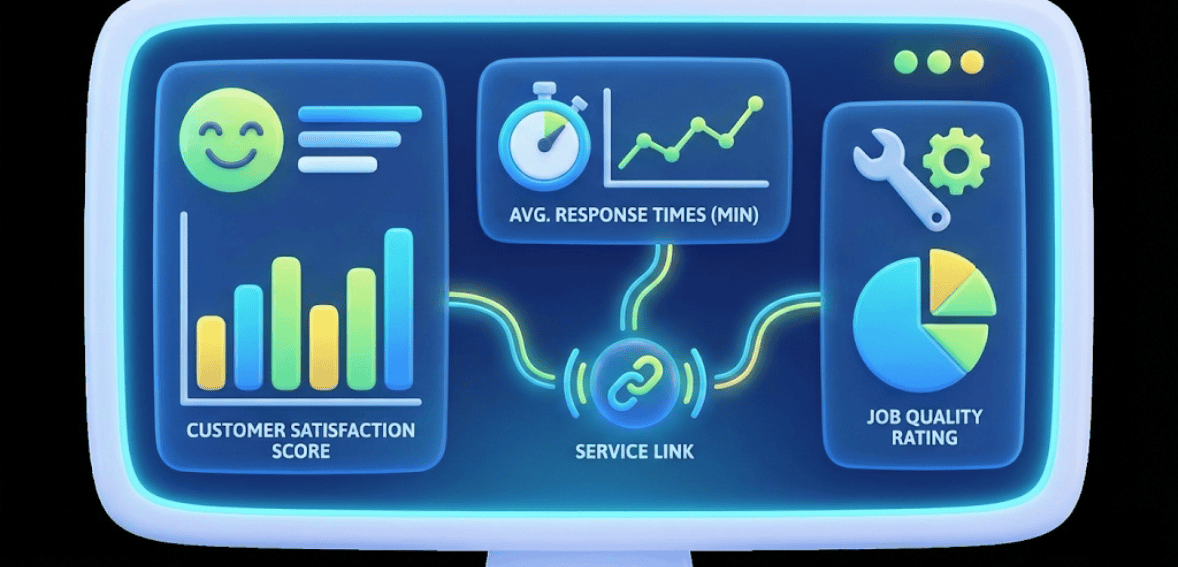
Customer satisfaction often feels subjective, but analytics brings objectivity to customer experience management. Data-driven field service operations track measurable indicators that directly affect how customers perceive service quality.
Response time, appointment accuracy, resolution speed, and communication consistency all influence satisfaction. Job management software automatically captures these metrics, allowing businesses to identify where the customer journey breaks down. For example, analytics may reveal that delayed arrivals, not service quality, drive most negative feedback. Or that repeat visits correlate strongly with lower satisfaction scores.
By identifying these drivers, service leaders can focus improvement efforts where they matter most. Rather than generic customer service training, teams can address specific pain points supported by data. Over time, this leads to measurable improvements in retention, referrals, and brand reputation.
Importantly, analytics also helps quantify the financial value of customer experience. Retention rates, repeat job frequency, and lifetime value can be linked back to operational decisions, reinforcing the business case for customer-focused improvements.
Avoiding Common Mistakes When Interpreting Service Data

While analytics offers powerful insights, misinterpretation can lead to poor decisions. One common mistake is focusing on isolated metrics without context. For example, pushing technicians to complete jobs faster without considering quality metrics may increase callbacks and customer dissatisfaction.
Another frequent issue is overreacting to short-term fluctuations. Performance data naturally varies week to week. Effective service business KPIs should be evaluated over meaningful timeframes to distinguish trends from anomalies. Analytics tools support this by offering rolling averages and comparative views that reduce knee-jerk reactions.
It’s also important to avoid data overload. When dashboards display too many metrics, focus is lost. High-performing organizations prioritize a manageable set of KPIs aligned with strategic goals. Additional data remains available for deeper analysis, but leadership attention stays concentrated on what truly drives outcomes.
Successful analytics adoption requires discipline as much as technology. Teams must learn not only how to access data, but how to interpret it responsibly.
Building a Data-Driven Culture in Field Service Organizations
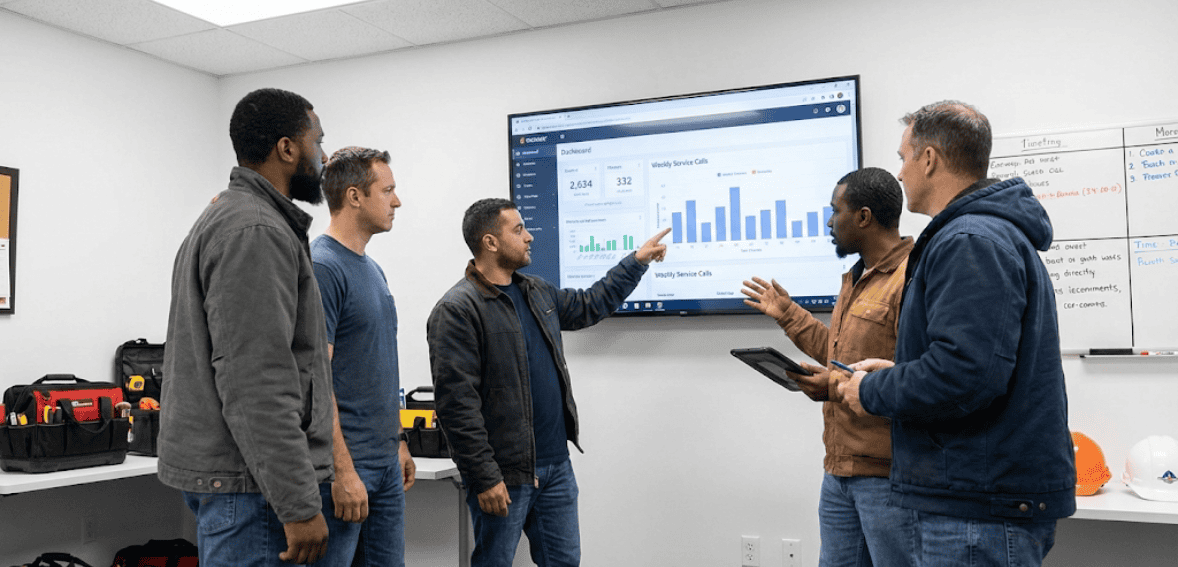
Technology alone does not create a data-driven organization. Culture plays a decisive role. When analytics is treated as a leadership-only tool, its impact remains limited. When insights are shared transparently, teams become engaged participants in the improvement process.
A data-driven culture encourages curiosity rather than blame. Metrics are used to understand processes, not punish individuals. Technicians see how efficiency improvements benefit their schedules and reduce stress. Dispatchers understand how decisions influence downstream performance. Leadership uses analytics to support teams rather than simply evaluate them.
Over time, analytics becomes part of everyday conversation. Decisions are framed around evidence. Experiments are tested and measured. Improvements are tracked and refined. This mindset shift transforms analytics from a reporting feature into a core operational capability.
Integrating Analytics Into Strategic Planning and Growth Decisions
As service businesses grow, strategic planning becomes more complex. Expansion into new regions, introduction of new services, and investment in staff or equipment all carry risk. Field service analytics reduces that risk by grounding decisions in evidence.
Analytics reveals which markets perform best, which services scale efficiently, and which operational models deliver sustainable margins. Growth decisions informed by data are more precise, reducing costly trial-and-error expansion.
Additionally, analytics supports investor confidence and internal alignment. Clear performance reporting demonstrates operational maturity and scalability, which becomes increasingly important as organizations grow.
In this way, analytics evolves from an operational tool into a strategic compass guiding long-term direction.
Conclusion
In today’s competitive service landscape, success depends on clarity. Job management software generates vast amounts of operational data, but its true value emerges only when that data is transformed into insight. Field service analytics empowers leaders to move beyond guesswork, enabling data-driven field service decisions that improve efficiency, profitability, and customer satisfaction.
By focusing on meaningful metrics, interpreting trends responsibly, and embedding analytics into organizational culture, service businesses gain control over complexity. Decisions become faster, smarter and confident. Ultimately, analytics doesn’t replace experience; it sharpens it, turning daily operations into a continuous source of strategic advantage.
FAQs
How often should field service analytics be reviewed?
Most businesses benefit from weekly operational reviews and monthly strategic analysis. This balance allows teams to address short-term issues while tracking long-term trends.
What’s the biggest benefit of data-driven field service decisions?
Clarity. Analytics replaces assumptions with evidence, helping leaders understand exactly where improvements will have the greatest impact.
Do small service businesses need analytics too?
Yes. Even small teams benefit from understanding job performance, customer patterns, and profitability early, preventing bad habits from scaling.
Can analytics improve technician performance without micromanaging?
Absolutely. When used correctly, analytics highlights process improvements rather than individual blame, supporting technicians instead of policing them.
How long does it take to see results from field service analytics?
Many businesses see measurable improvements within a few months when data is consistently reviewed and acted upon intentionally.