
Remote Diagnostics and Virtual Service: Fixing Problems from Afar
In 2026, how contractors are fixing issues using remote diagnostics field service is changing drastically. Nowadays, there’s no need to drive to a job site just to solve an issue, as many issues can be checked from either your office or even from your mobile phone. This change is helping contractors save time, reduce fuel costs, and work with many more clients in a single day.
For field service companies that operate with a focus on efficiency and intelligent scheduling, the change presents a huge competitive advantage. Rather than automatically dispatching a technician, you can first assess whether the problem can be resolved without a field service visit to the location; in many cases, this will be true. Consequently, the customer will receive quicker service, while your company will maintain higher margins.
Remote diagnostics field service does not eliminate your need to perform work face-to-face; it allows you to leverage technology efficiently. When correctly implemented, this approach will result in a higher ratio of first-time fixes, better communication with customers, and ultimately improved overall responsiveness of your operation.
What Remote Diagnostics Field Service Really Means

Remote diagnostics field service refers to the practice of identifying problems in equipment and, in some cases, offering solutions, without physically visiting the premises. You use contractor technologies, video conferencing, and interconnected systems to obtain the needed information without physically visiting the site.
Sometimes you’re talking a customer through a fix on video. Other times, you’re staring at live data on a remote monitoring platform, or you’re getting instant IoT alerts from devices out in the field. You don’t have to rely on assumptions anymore. But instead of words, you’re seeing the results in numbers or a live video feed.
For example, if a customer calls because their HVAC unit has stopped cooling, you first review the system data before sending a technician. If the airflow is low, the most likely cause is a clogged filter. You can then call the customer and guide them through basic troubleshooting. In most cases, this resolves the issue, and the system is back up and running within minutes.
That’s the essence of virtual field service support. It makes things faster and keeps your business flexible.
IoT Sensors and Predictive Alerts
Modern equipment is becoming smarter with AI and predictive alerts. These days, HVAC systems, generators, pumps, and various industrial machines are equipped with AI sensors that transmit real-time data. That is what people talk about when they say remote maintenance with IoT.
Remote monitoring tools mean that you don’t wait until something goes wrong. If something goes wrong with a machine and, say, temperature spikes or pressure drops or airflow becomes blocked, you receive an alert immediately.
What’s great about this? To go a step further, you typically see the issue before your customer even realizes. Gone is the era of simply biding time until a panicked phone call follows a mechanical failure. You can reach out first.
For example, a system may be beginning to overheat. You can tell your customer to switch it off before it escalates. And if airflow drops, you could recommend that they check the filter. Occasionally, the system even fixes a minor glitch on its own.
Such an approach to service prevents emergencies. It signals to customers that you’re looking for them, not just waiting for something to go wrong. When customers begin to see you as a trusted partner rather than just a repair provider, your relationship becomes stronger.
Virtual Service Calls and Eyes-On Inspections
Not all systems include smart sensors. This is where virtual service calls become valuable.
Customers can share the issue with you in real time using simple video tools. A plumber can walk a homeowner through turning off a leaking valve. An HVAC technician might ask a customer to aim the camera at the thermostat. An electrician can look at a breaker panel via video.
This is a vital part of the field service for remote diagnostics. It lets remote-troubleshooting contractors take action immediately, rather than waiting for travel time.
Sometimes the solution is simple. It might mean resetting a breaker, adjusting a setting, or clearing an error message. You don’t need special tools for these small fixes.
Even if the problem necessitates a visit, virtual service calls help prepare for it. You can quickly locate the specific information you need. You can send the right technician. You do not increase the probability of a second visit.
Customers appreciate this speed. They are immediately supported instead of waiting hours or days.
AR Remote Assistance for Field Technicians
But remote diagnostics field service is not only utilized with customers. It also helps technicians in the field.
With AR remote assistance, a senior expert can see through the eyes of an on-site technician. The field tech uses a smartphone or an AR-enabled device to stream live video back to the office. The expert can walk them through the process.
This type of remote field service assistance boosts the first-time fix rate. A junior technician can do more complicated jobs because they have real-time support.
Rather than sending multiple technicians to a single location, you send one and connect them to support virtually. This lowers labor costs and travel time and increases repair accuracy.
AR remote assistance empowers your entire team. It allows knowledge to be shared instantly across your team.
Best Scenarios and Benefits of Remote Diagnostics Field Service
Remote diagnostics field service works best in specific situations. The best use cases for remote field service are software adjustments, system resets, configuration issues, and early diagnosis. Since many problems have already been solved remotely by IT service companies, HVAC, plumbing, and electrical contractors have begun using remote diagnostic field service.
The primary advantage of remote diagnostics is speed. A customer can receive assistance within minutes of contacting the service provider. The initial response creates a lasting impression.
Another benefit is cost savings, which remote field service creates by eliminating travel expenses and time from the field to the customer’s premises; you may choose to retain as much of your profit margin as possible. Alternatively, you can offer customers lower costs for virtual field service.
Remote monitoring field service has also broadened the potential service area to assist customers who are outside of traditional service areas when remote hands-on work is not required.
However, many repairs requiring hands-on labor cannot be performed virtually; these include, but are not limited to, replacing pipes, installing wiring, or swapping out mechanical components. Therefore, using remote diagnostics field service solutions must be the first step in the service process.
When you can resolve a problem remotely, it benefits all parties involved. Even if you are unable to resolve the problem remotely, you will have all the information you need when you arrive.
How You Can Integrate Remote Diagnostics Into Your Field Service Business
If you want to introduce remote diagnostics into your field service business, you don’t need a lot of money to get started. You can start small.
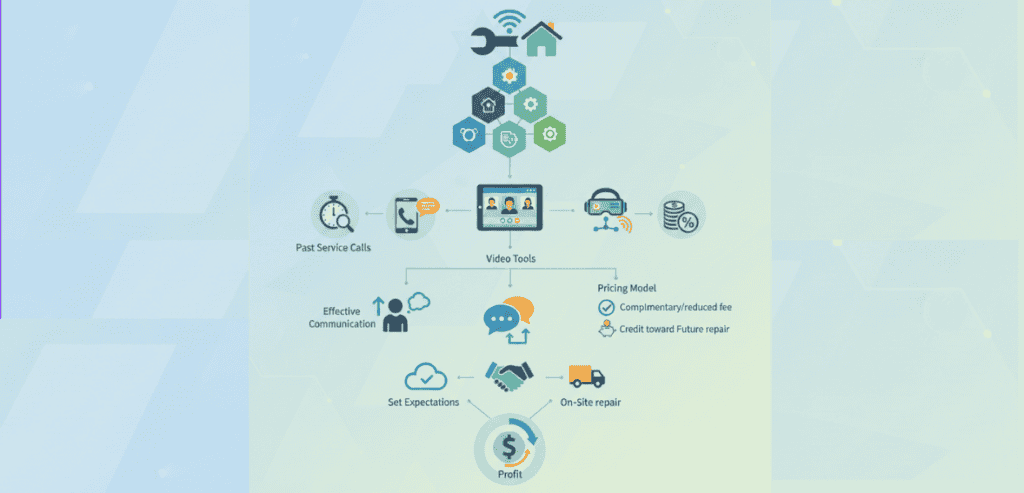
The first place to start is with your past service calls. Often, common problems could have been solved with a little help over the phone. Most repeat calls involve very minor problems and are excellent candidates for virtual assistance.
The next item is making sure your technicians have good video tools. Simple options like Zoom work well for video chat and will likely suffice as you grow, but eventually you may want to explore partnering with a company that offers remote maintenance platforms and AR software.
Techs should be trained on how to communicate effectively. Troubleshooting over the phone requires the ability to explain things clearly and to communicate patiently. It is very important that your technicians have good communication skills.
Your pricing model is also an important consideration. Some businesses offer a complimentary review of their pricing structure, while most charge a reduced fee for remote service calls. An increasing number of companies also apply the fee paid for remote service toward a future repair, if one becomes necessary.
Finally, it’s important to clearly set expectations for the customer. Let your customers know that remote service is just one step, and if they still have problems, you will send someone out to repair it.
By planning correctly, remote diagnostics can be a source of profit rather than just an experiment.
Conclusion
The future of field service is being drastically changed by the introduction of remote diagnostics, which use technology, communication, and intelligent workflows to improve customer satisfaction and reduce unnecessary travel for contractors and their customers.
Utilizing remote maintenance IoT tools, virtual service calls, AR remote assistance, and field service remote monitoring systems allows you to work smarter and respond more quickly. While virtual service does not replace hands-on work, it provides an excellent starting point.
Contractors who utilize virtual field service support today will be positioned uniquely in 2026 and beyond. They will be able to respond to more customer calls each day, reduce costs, and provide the fast response customers have come to expect. To start, begin with an incremental approach and build a better service and support model that will operate effectively whether you are on-site or remote.
Frequently Asked Questions
What issues can be resolved using remote diagnostics in field services?
Software resets, configuration modifications, and minor tweaks are typically the focus; often, early diagnostics can be resolved remotely before sending a technician.
Are customers open to using virtual service calls?
The majority of customers are happy to receive immediate assistance and are willing to pay a lower cost. When the reason for trying the remote option is clearly less than an in-person visit, customers often opt for the remote method first.
What type of hardware is required to get started?
A smartphone and stable internet connection are enough to get started; advanced capabilities may include using remote maintenance IoT sensors and/or augmented reality (AR) devices to provide remote assistance.
Can all contractors utilize remote diagnostic contractor methods?
Most contractors can use it to perform remote inspections or provide remote guidance to a technician. Although not all repairs would qualify, the vast majority of first-level diagnostic issues can be performed virtually.
How do you determine the price for remote services?
Typically, businesses charge a lower rate for remote assistance than for an in-person visit; often, they credit any portion of the remote-assistance fee toward an in-person repair if it becomes necessary.