
Automate and Elevate: Using Automation to Grow Your Electrical Contracting Business
Running an electrical contracting business requires both technical skill and operational discipline. Owners growing from one-truck operations to teams often find administrative tasks overwhelming before the technical work does. That’s where automation changes everything.
The features of electrical contractor software let business owners automate manual tasks, saving hours. Instead of spending evenings on paperwork or invoices, owners can focus on customers, developing crews, and business strategy. Automation doesn’t remove your business’s personal touch; it simply clears clutter, so it shines more often.
Field service management software and automation is transforming the electrical industry. Automation reduces bottlenecks, removes repeated tasks, and creates a smooth, organized workflow for every job.
To see how automation elevates an electrical business, identify where you lose time and limit growth. Automate these points to gain revenue, reduce errors, and improve the customer experience.
Repetitive Tasks That Drain Time and Are Perfect for Automation
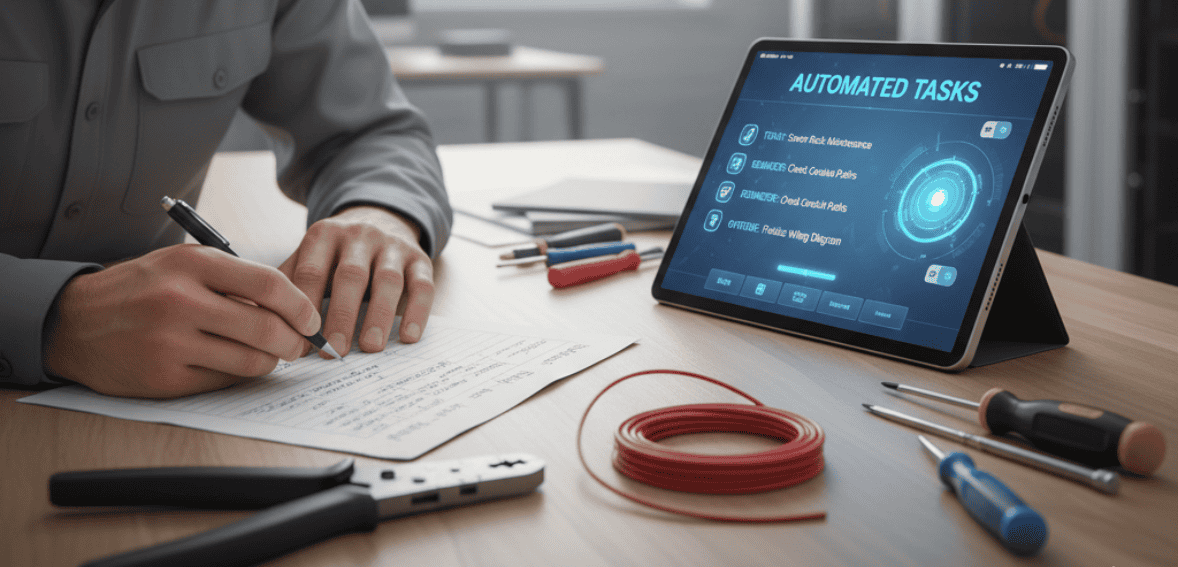
Every electrical business, whether newly launched or decades old, deals with the same operational bottlenecks. Dispatchers scramble to update schedules. Techs call or text for job updates. Quotes take too long to prepare. Invoices are delayed because paperwork sits in service trucks. Customers forget their appointment and aren’t home when the technician arrives. Parts shortages derail jobs at the last minute.
These issues have one thing in common: they stem from manual, repetitive tasks that humans simply aren’t optimized to handle at scale.
Electrical contractor software solves these issues by automating tasks such as:
- Recurring job scheduling for preventive inspections, annual maintenance contracts, warranty checkups, and seasonal system evaluations
- Follow-up messages to customers after estimates, ensuring no quote goes stale because a team member forgot to check in
- Automatic work order creation when a customer submits a request online or via a contact form
- Invoice generation the moment a technician marks a job as complete
- Real-time syncing of job notes and photos, eliminating the need to re-enter information back at the office
- Status updates to dispatchers, such as “On the way,” “Job started,” “Job completed,” all triggered automatically.
- Reordering materials when inventory levels drop below a certain threshold
Removing these repetitive responsibilities significantly reduces the mental load on both office staff and technicians. More importantly, it prevents costly oversights like forgetting to invoice a job, double-booking a technician, or missing a follow-up on a large commercial quote.
When your team starts using automation to eliminate phone tag, manual entries, and scheduling errors, they immediately reclaim hours for higher-value work. At the business level, this directly results in faster job completion, fewer missed billing opportunities, and better cash flow.
Scheduling & Dispatch Automation: The Heartbeat of a More Efficient Electrical Business
Scheduling is often chaotic. With installations, service calls, emergencies, and contracts to juggle, a single delay can disrupt the whole day.
This is where field service automation proves invaluable.
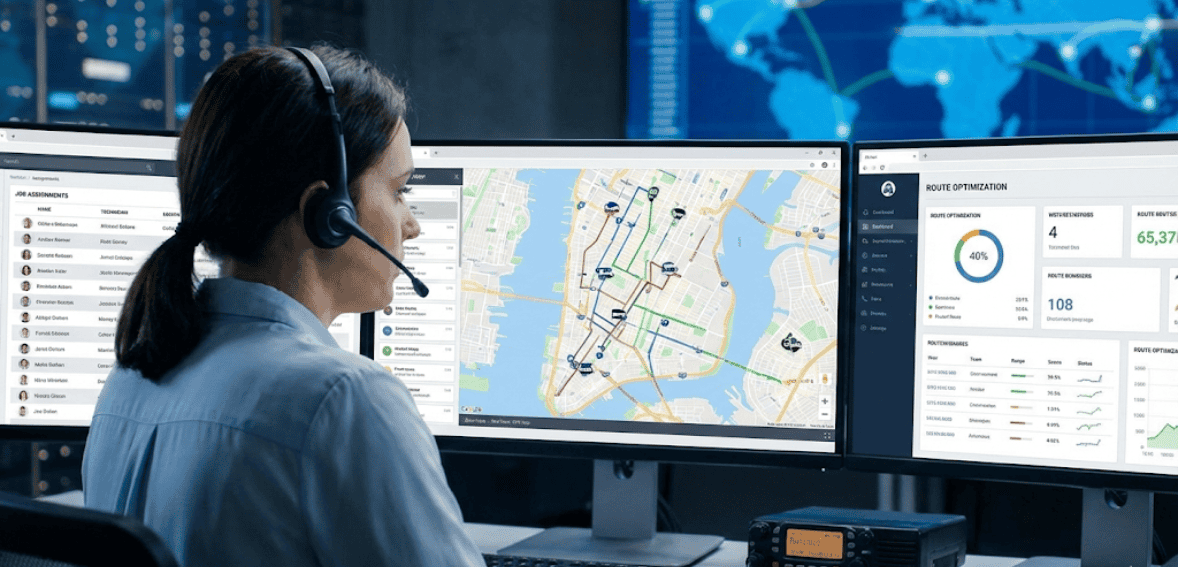
Modern electrical contractor software uses intelligent scheduling tools that automate:
- Technician assignment based on location, skillset, and availability
- Route optimization to reduce drive time by as much as 20%
- Automatic reshuffling of schedules when an emergency call comes in
- Instant updates to technicians’ mobile devices
- Automated customer notifications with new ETAs
Instead of a dispatcher manually adjusting dozens of appointments, the system recalculates the most efficient schedule and updates everyone instantly.
How Automated Scheduling Works in Real Time
Imagine your team is halfway through the day when a high-priority commercial client calls—an outage has shut down half their building. Traditionally, your dispatcher would flip through notes, call technicians, manually reshuffle jobs, and hope nothing fell apart.
With automation:
- The system identifies the nearest qualified technician.
- It reorders non-urgent jobs automatically.
- It sends notifications to affected customers.
- It updates the technician’s route and dispatches the emergency call immediately.
This prevents human error, reduces response times, and enables electric companies to handle more calls in the same number of work hours.
Automated Invoicing & Payment Reminders: A Direct Path to Better Cash Flow

Many electrical businesses lose revenue not because jobs aren’t completed, but because billing isn’t timely. Paper invoices get lost. Digital invoices get delayed. Customers forget to pay. Office staff get overwhelmed.
Automation eliminates all these failure points.
With workflow automation, the moment a job is marked complete:
- An invoice is automatically generated.
- Photos, notes, and materials are already attached.
- A digital payment link is sent to the customer.
- Automatic reminders follow at scheduled intervals until payment is made.
This single automation can transform cash flow almost overnight. Consistent reminders gently nudge customers, and because payment is as simple as clicking a link, the number of overdue invoices drops dramatically.
For many contractors, late payments fall from weeks to days simply because billing becomes immediate and automated.
Balancing Automation with Personal Service: The Human Touch Still Matters
One concern many electricians have is that automation will make their business impersonal. But in reality, automation strengthens human connection rather than replacing it.
When the tedious, repetitive work disappears:
- Technicians spend more time talking with customers.
- Owners spend more time planning and improving operations.
- Dispatchers spend more time solving real problems instead of typing notes.
- Customers experience quicker responses and smoother service flows.
Automation handles the tasks customers don’t care about, like reminder emails or paperwork, so your team can focus on the relationship. This combination of efficiency + personalization is exactly what fuels electrician business growth today.
Scaling Your Electrical Business Through Strategic Automation
When an electrical contractor adopts automation, the business shifts from reacting to jobs to operating with a structure for long-term growth. Scheduling becomes predictable, instructions to technicians are clearer, customers get automatic updates, and job records are more complete. Business moves more clearly and with less stress.
Automation doesn’t only save time; it increases operational bandwidth. A small team becomes as productive as a larger one. What felt overwhelming is now manageable. Capacity rises not just from new hires but also from the existing team finding space to work more effectively.
This is why electrical contractor software often leads to business expansion without immediately adding overhead. When each technician completes more jobs per week, and each dispatcher oversees a broader workload without burning out, the company is already growing. Many owners describe automation as the moment their business became a “real” operation rather than a constant scramble to stay afloat.
The Financial Impact of Automation: Where the Real ROI Comes From
When owners first think about adopting electrical contractor software, they often focus on the subscription cost. But the true financial story unfolds after implementation, when automation begins removing bottlenecks that once caused hidden losses.
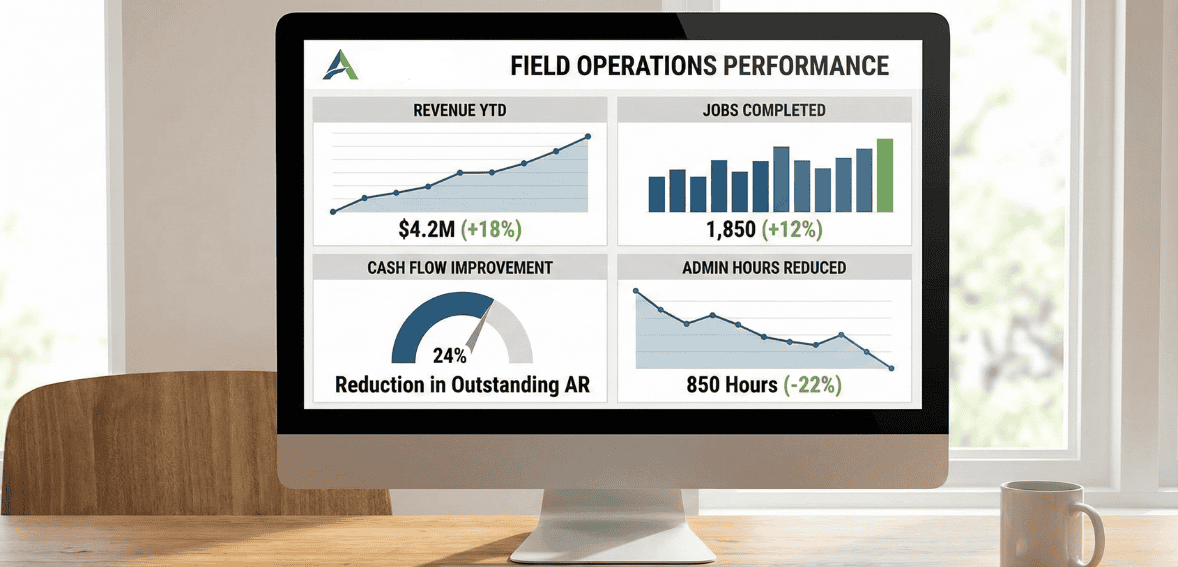
One of the biggest financial gains comes from reducing the gaps between completing a job and getting paid for it. When invoices are generated automatically and delivered immediately, the entire cash flow cycle accelerates. Outstanding balances shrink. Late payments drop. The business becomes less dependent on chasing checks and more grounded in consistent, predictable revenue.
Another major cost savings appears in reducing administrative errors. A single missed invoice, a forgotten inspection, an improperly scheduled follow-up, or a wrongly entered rate can cost hundreds or thousands of dollars over time. Automation dramatically decreases these mistakes because workflows follow a consistent digital pattern rather than relying on manual memory or handwritten notes.
Increased employment is also part of the financial return. When a technician spends less time updating paperwork and more time solving actual electrical problems, each workday becomes more productive. More finished jobs naturally translate into more revenue. When scheduling is optimized with automated routing, technicians spend less time driving and more time working, leading to even greater output.
Ultimately, the financial power of automation comes from reducing friction at every stage from the moment a lead calls to scheduling, dispatching, job execution, invoicing, and payment collection. The cumulative effect is a healthier, more profitable electrical business with fewer operational leaks.
Workflow Automation for Multi-Team and Multi-Technician Operations

For businesses with several electricians, automation becomes the backbone of coordination. Each technician has different strengths, licenses, certifications, and areas of expertise. Assigning the right person to the right job matters not only for quality but also for efficiency and customer satisfaction.
Electrical contractor software makes this matching process seamless by analyzing technician profiles, availability, locations, and job requirements. Instead of dispatchers relying on memory, guesswork, or rushed decision-making during busy periods, the system automatically recommends the ideal assignment. Over time, this consistency improves first-time fix rates and reduces repeat visits because jobs are matched with the right skills from the start.
Communication within the team also becomes smoother. Instead of techs calling the office for updates, everything they need appears in real time on their mobile app. Notes, photos, diagrams, and parts lists sync instantly. Dispatch doesn’t need to repeatedly explain changes, because every adjustment updates the job record automatically.
This creates a more professional workflow where each team member moves confidently through their day with full information. Even new hires become productive faster because the software guides them through a consistent process rather than forcing them to learn a dozen manual habits from scratch.
Strengthening Customer Relationships Through Predictable, Automated Processes

Customers notice efficiency even if they don’t know the technical details happening behind the scenes. Automated appointment confirmations, reminders, and ETA updates give customers confidence that the company is organized and values their time. When a dispatch system automatically sends a technician’s name or arrival window, it reduces anxiety and builds trust before the technician even steps inside.
After the job, automated follow-up messages or feedback requests show professionalism and care. Customers feel valued because the communication doesn’t stop the moment the technician leaves. Instead, the business stays connected in a gentle, thoughtful way that often leads to repeat service and referrals.
Automation also helps maintain transparency. When customers receive completed job summaries, photos, or explanations instantly, they never feel kept in the dark. The smoother and clearer the experience, the more likely the customer is to return and recommend your business to others.
This customer experience improvement becomes one of the strongest growth drivers. An electrical contractor who consistently arrives on time, communicates well, bills promptly, and follows up reliably earns a reputation for dependability, a powerful asset that automation makes easy to maintain.
Choosing the Right Electrical Contractor Software for Your Business

With so many digital tools available today, choosing the right electrical contractor software is an important step. The best solution is one that blends into your daily workflow without feeling complicated or difficult to adopt. Most modern platforms are designed so that even non-technical users can navigate them easily, with intuitive screens and minimal training required.
The ideal software should unify job scheduling, dispatching, invoicing, customer communication, and reporting into a single system. When everything lives inside the same platform, your team avoids switching between disconnected apps or manually transferring information from one system to another. This integration makes automation truly powerful, as data flows effortlessly from start to finish.
Scalability is another important consideration. A tool should serve your needs today but also support your business as it grows. Whether you have one technician or twenty, the platform should adapt without forcing you to rebuild processes from scratch.
Most importantly, the software you choose should reflect your business values. If you value speed, look for a platform known for fast workflows. If you value customer experience, choose one with strong communication features. If you value compliance, find a system that documents everything thoroughly.
When the right match is made, the software becomes an extension of your business, not a burden, but a partner that makes every part of your operation smoother and more organized.
Conclusion: Automation Isn’t About Replacing People, It’s About Elevating Them
Automation is not about removing the human element from electrical contracting. It’s about removing the unnecessary burdens that prevent people from doing their best work. When repetitive tasks disappear, technicians gain more time for craftsmanship, dispatchers gain clarity, owners gain control, and customers gain a better experience.
Electrical contractor software becomes the engine that supports this transformation. It organizes the chaos, creates consistency, and opens the door for sustainable growth. Whether your business is brand new or already thriving, automation gives you the power to scale without losing the personal service that sets your company apart.
Growing an electrical contracting business isn’t just about doing more work. It’s about working smarter, communicating better, and eliminating friction wherever it appears. Automation delivers exactly that and once you experience the difference, it becomes almost impossible to imagine running your business any other way.
FAQs
How does automation impact the day-to-day operations of an electrical contracting business?
Automation streamlines everything from scheduling to invoicing, reducing administrative stress and making each day more predictable. This allows technicians and office staff to focus on service rather than chasing paperwork, ultimately creating a smoother workflow.
Will electrical contractor software help if my business is still small?
Absolutely. Small businesses often benefit the most because automation prevents early inefficiencies from becoming long-term problems. Even one-truck operations see major improvements in organization, billing speed, and customer communication.
Does automation reduce the need for office staff?
Not necessarily simply shift their workload. Instead of manually handling repetitive tasks, staff can spend more time on customer service, project planning, and handling higher-level responsibilities.
How does automation reduce errors in electrical contracting workflows?
Automated systems follow consistent logic every time, preventing issues such as missed appointments, forgotten invoices, or incorrect job notes. Because data flows automatically between steps, there are fewer opportunities for mistakes.
Is automation difficult for technicians to learn?
Most technicians adjust quickly because the tools are designed for real-world efficiency and simplicity. Mobile apps guide them step by step, making the transition smooth, even for techs who aren’t very tech-savvy.