
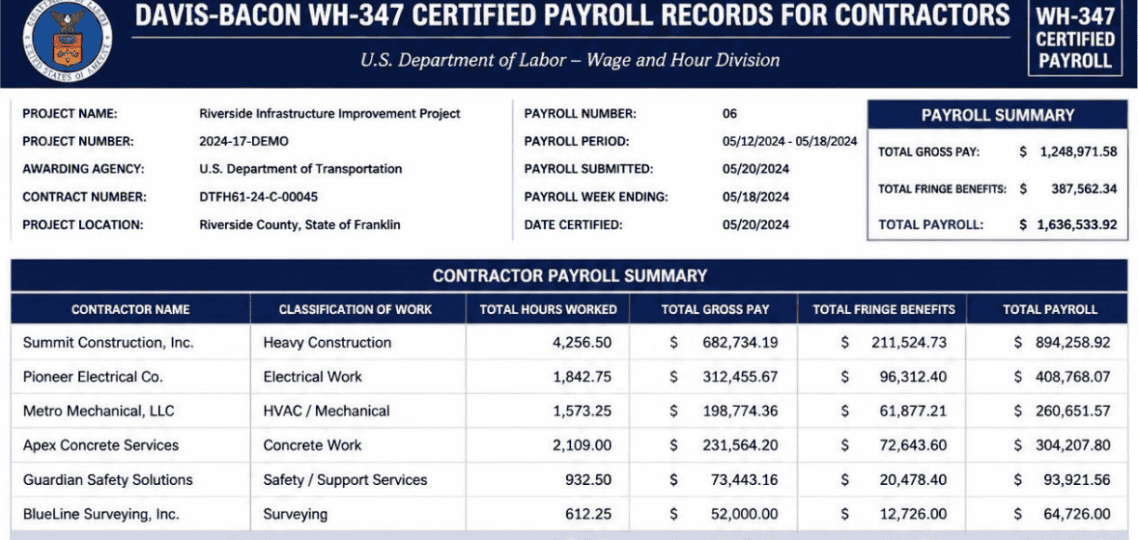
Davis-Bacon WH-347 Certified Payroll Records for Contractors
Winning a federal construction contract feels great. Then the paperwork starts. If your project uses federal money, you cannot just cut checks and move on. You must prove, week after week, that you paid every worker a fair wage. That proof has a name: WH-347 certified payroll.
Improperly completing or missing a WH-347 form can lead to fines severe enough to cost you future federal contracts, along with unpaid wages and delayed payments. This is your plain-speaking, no-nonsense, practical, and updated 2026 guide.
What Is the Davis-Bacon Act?
The Davis-Bacon Act became law in 1931. Its goal is simple. It protects local wage standards on public jobs. Under the law, contractors and subcontractors must pay “prevailing wages” to laborers and mechanics on federal projects.
These regulations apply to contracts exceeding $2,000. This amount applies to the construction, alteration, or repair of public buildings and public works. The prevailing wage consists of a base hourly rate and fringe benefits. The U.S. Department of Labor determines these rates on a regional and employment classification basis.
Many other federal laws use these same regulations. They are collectively referred to as the Davis-Bacon and Related Acts (DBRA). Therefore, the same wage obligations can be imposed on road construction grants, the building of schools with federal assistance, and clean water projects.
What Is WH-347 Certified Payroll?
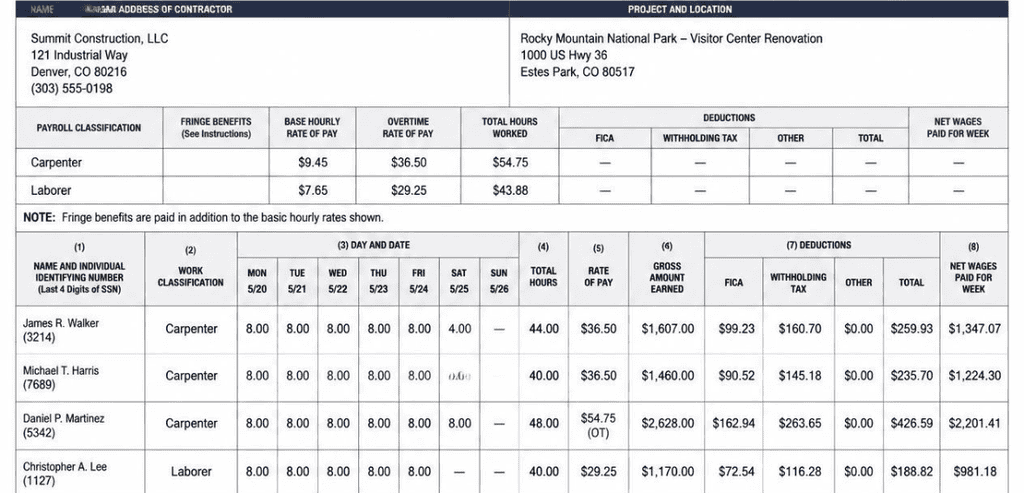
Certified payroll is a special weekly report. It shows exactly what you paid each worker and how you paid it. The standard tool for this report is Form WH-347.
The form asks for detailed data. You list each worker, their job classification, hours worked each day, pay rates, gross wages, deductions, and net pay. In short, it is a full snapshot of your labor spending for one week.
The report is only “certified” when you sign the Statement of Compliance. By signing, you are making a legal guarantee and are subject to legal ramifications if the numbers are false. You are also agreeing that all employees were paid at least the required prevailing wage and fringe benefits.
Here is an important detail that many people on their first contract do not realize. You do not have to use the WH-347 form. However, you do have to submit payroll data weekly. The Copeland Act requires all contractors on federally funded or assisted contracts to submit a wage statement on a weekly basis. Most contractors do use WH-347 to meet this requirement.
When Does a WH-347 Certified Payroll Contractor Need to File?
Timing trips up a lot of teams. You must submit certified payroll every single week that work happens on the covered project. This holds true even during slow weeks and short work stoppages. If any covered labor took place, a report is due.
You file the report with the contracting agency, not always directly with the Department of Labor. Prime contractors also collect certified payrolls from their subcontractors. So the paper trail flows up the chain. Everyone who touches the job stays accountable.
Each weekly report gets its own number. You start at “1” and count up in order. This helps auditors confirm that no week is missing. A gap in the sequence is an instant red flag.
What Goes Inside the WH-347 Form
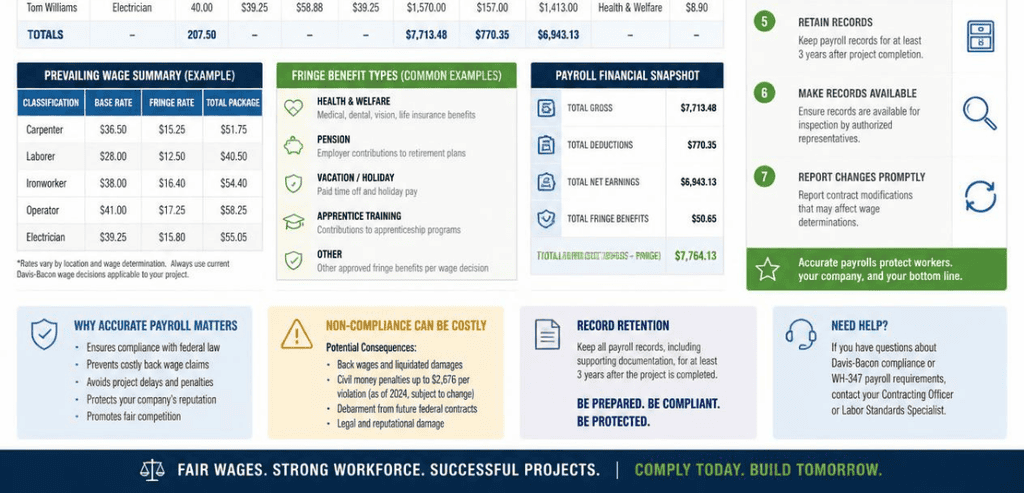
The form has two pages, and each one matters. Page one holds the raw payroll data. Page two holds your sworn statement.
For the heading, write the business name, address, and indicate if you are a subcontractor or a contractor. Then write the project name, the project location, the contract or project number, and the wage determination number. There is little to no room for mistakes here. These details must match the contract documents exactly.
The next segment is the worker grid. Here you write the employee’s name, an ID number, and their labor classification. You indicate if they are a journeyworker or a registered apprentice. You also record regular time and overtime for each day of the week. The form will use that information along with the pay you report and any deductions to calculate net pay.
Fringe benefits must be addressed. They are included in the prevailing wage, not an extra benefit. You fulfill the fringe obligation in one of two ways. You either pay the amount as additional cash wages, or you make a contribution to a bona fide benefit plan, such as health benefits or an employee retirement plan. The form must clearly show which method you chose.
The Statement of Compliance
Page two is the heart of the whole process. This is the Statement of Compliance. By signing it, you certify that the payroll is accurate and complete. You also confirm that no worker was paid below the required rate.
Do not treat this as a formality. A false certification is a federal crime. The Department of Labor refers serious cases to the Department of Justice. So sign only when you know the data is right.
The New Online WH-347 Tools
In December 2025, the Department of Labor rolled out fresh resources to make this easier. These tools aim to cut errors and save time. For a busy WH-347 certified payroll contractor, they are worth a close look.
U.S. Department of Labor
The Wage and Hour Division has made its Form WH-347 available online as a fillable form. Now you can enter your data and complete the form as much as possible from your internet browser. This form will also automatically calculate the wage and/or overtime and/or deduction math for you, eliminating a major source of errors.
The annotated WH-347 form guide includes a detailed description of each section with helpful notes to fill the form. This will assist contractors, subcontractors, and consultants, as well as those in compliance positions, to accurately fill the WH-347 form. These resources are available for use at no charge on the DOL WH-347 form resources page.
Wage and Hour Division Administrator Andrew Rogers wants contractors to be able to meet the requirements of the form with ease, without the burden of stumbling through it. The current form has the OMB control number 1235-0008 and is valid until January 31, 2028.
How to Complete WH-347 Certified Payroll the Right Way

Start by gathering your data before you open the form. Pull your project details, worker roster, hours, and the correct wage determination. Doing this first prevents stop-and-start errors.
Provide the requested information in the header section, and then move to the employee rows, one employee at a time. Correctly classify each employee, as misclassification can be a difficult and costly error to correct. If an employee performs more than one duty, for example, as a truck driver and as a framer, then that employee must be recorded as performing separate duties. The employee must then be compensated as a framer and as a truck driver, respectively.
Once the data is recorded, check the data against your actual timesheets, and then you can sign the Statement of Compliance for the report. You must submit the report to the Contracting Agency within the allotted time. The Department of Labor estimates that it takes approximately 55 minutes to complete the form. You can shorten this time with good records and the fillable tool.
Keep records for prevailing wage jobs and for private jobs separate. This is a major change in structure for contractors. If a crew divides their work time between a federal job and a private job, you must have clear and accurate records for each job. Blending the two makes an audit very painful.
Recordkeeping Rules for Certified Payroll
Filing the report is only half the job. You must also keep the records. Under the Davis-Bacon Act, contractors must retain payroll records for at least three years after a project ends.
That three-year window is a federal floor, not a ceiling. Many states demand more. California requires five years. New York requires six. Smart contractors keep everything for at least five years to stay safe under every rule.
Your records must be ready on demand. If a Wage and Hour investigator asks, you produce them promptly. “On demand” does not mean weeks later. Digital records are fine, as long as they are organized, complete, and readable. A shoebox of loose timesheets will not survive an audit two years down the road.
Penalties for Non-Compliance
There are serious repercussions for getting this wrong, both financially and for your reputation.
In each situation, the financial penalties come first. The agency has the authority to withhold contract payments to compensate for unpaid wages. As the employer, you may be liable for back wages for underpaid employees. You may also be subject to liquidated damages for violations relating to overtime.
After the financial penalties come the more serious repercussions. The agency has the authority to terminate your contract. They can also impose a three-year debarment from federal work. For contractors who primarily work with government contracts, debarment can be fatal to the business.
As for the worst outcomes, the penalties become criminal. Falsifying a certified payroll report is a crime on the federal level. It can result in financial penalties and time in federal prison. The Copeland Anti-Kickback Act adds additional penalties for the crime of forcing an employee to return part of their wage. This is not theoretical; the Department of Labor actively works on these cases each year.
How to Stay Compliant and Stress-Free
The best defense is a steady routine. Run internal audits before you submit each report, not after a problem appears. Double-check worker classifications against the wage determination every time. Confirm that fringe benefits are documented and paid correctly.
The required Davis-Bacon notices must also be posted at the job site. This shows employees their rights and demonstrates your good faith to the government. Also, provide training for your payroll staff on the new fillable form. These habits, though small, keep you from the large penalties described above.
Also, many contractors rely on payroll software or a compliance specialist. The expense is worth it when you consider the cost of one violation. The objective should be to make certified payroll a standard task in managing a project, not a fear-inducing requirement.
Conclusion
WH-347 certified payroll is not just red tape. It is the paper backbone of fair pay on public projects. For any WH-347 certified payroll contractor, mastering it protects your workers, your profits, and your ability to bid again.
The rules are strict, but they are learnable. Pay prevailing wages. File accurate reports every week. Sign the Statement of Compliance honestly. Keep clean records for at least three years. Do those four things well, and Davis-Bacon compliance becomes routine instead of risky. Use the Department of Labor’s free fillable form and annotated guide to make the whole process faster and cleaner.
Frequently Asked Questions
Is Filing Form WH-347 Mandatory for Federal Contractors?
Using the WH-347 form itself is optional. Submitting weekly certified payroll data is mandatory on covered federal and federally assisted construction contracts over $2,000. Most contractors use WH-347 because it satisfies the reporting rules in one clean document.
How Long Must a Contractor Keep Certified Payroll Records?
The Davis-Bacon Act requires you to keep records for at least three years after the project ends. Some states, such as California and New York, require longer periods. Keeping records for five years is a safe habit for most contractors.
What Happens If I Submit a False Certified Payroll Report?
Falsifying a certified payroll report is a federal crime. It can lead to fines, imprisonment, contract termination, and debarment from federal work for up to three years. The Department of Labor refers serious cases to the Department of Justice, so accuracy is essential.
How Are Fringe Benefits Handled on the WH-347 Form?
Fringe benefits are part of the prevailing wage, not an extra. You can meet the requirement by paying the fringe value as cash on the paycheck. You can also contribute to a bona fide benefit plan, such as health insurance or a retirement fund. Either way, your records must show how you met the obligation.