

California Home Improvement Change-Order Signature Records
Picture this. You hire a contractor to remodel your kitchen. Halfway through, the crew finds rotted subflooring. The contractor says it needs to be replaced and quotes you a number over the phone. You nod. Work continues. Weeks later, the final bill lands with thousands of dollars in “extras” you never signed for. Now you are stuck in a dispute, and nobody can prove what was agreed.
This happens across California. The good news is this is entirely preventable. As far as the law goes, this has to do with contracts, and with contracts comes a signed document. Change order signatures do have to be kept on file, and the law is there for good reason.
The goal of this document is to provide a better understanding of the requirements for change orders in home improvement in the state of California, and in turn, show homeowners and contractors what a signed change order looks like.
What Is a Change Order in a California Home Improvement Project?
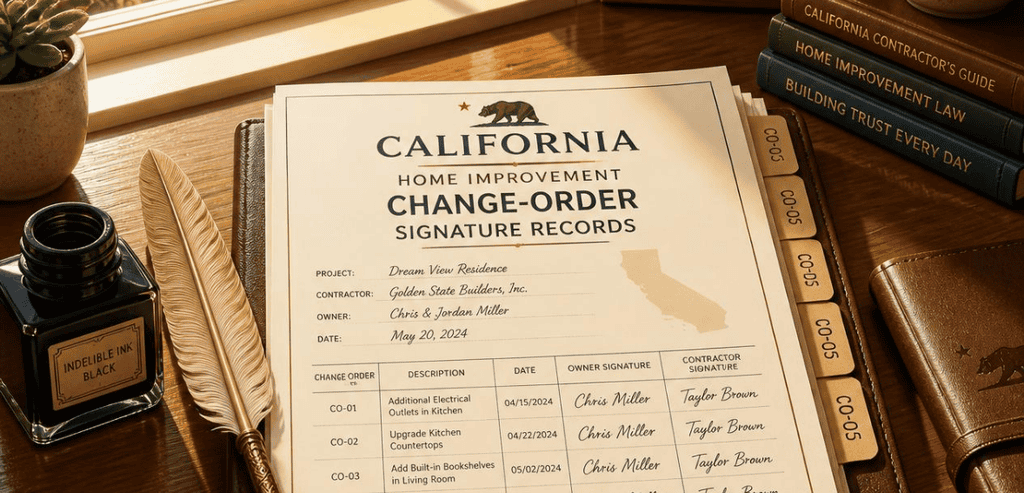
A change order is a written document that modifies the original home improvement contract. It covers extra work, changes in scope, added materials, or any adjustment to price or schedule that comes up after the deal is signed.
Think of this as an official update to the original agreement. The primary contract is the baseline. This change order is a record of anything that moves away from the baseline during the course of the project. Some common triggers are unforeseen circumstances, such as old wiring or water damage, new requests from homeowners after the project has started, or changes in code that are found during demolition.
This is clearly the most difficult to understand. In California, a verbal approval such as “yeah, go ahead” doesn’t count. Change orders become part of the contract when both parties sign the order before the new work is done. The signature and timing, actually, formalize the nature of the contract.
California Home Improvement Change Order Requirements Under the Law
California regulates home improvement contracts more tightly than most states. The rules live in the Business and Professions Code, and they exist to protect homeowners from surprise charges and shady billing.
First, any project estimated at over five hundred dollars requires a contract. Each contract signed must be done before any of the work begins. This makes up the structure of home improvement contracts.
The statute, Business and Professions Code Section 7159, requires each home improvement contract to have a change-order form. This form is not a part of the contract until it is a written order signed by both parties before the work is done. This statute requires that a change-order form be preceded by the notation “Note About Extra Work and Change Orders,” along with a statement that advises the buyer that “extras” will only be binding if they are prepared in writing and signed before the work that is the subject of the change order.
One of the home improvement statutes, Section 7159.6, describes the consequences of not complying with the statute. According to this statute, a change order will not be binding to the homeowner if the written order does not state the additional work that is to be done, the additional cost that will be incurred, and the additional time that will be required to complete the work. This statute also protects the contractor in that he will not be liable to perform additional work that is not approved in writing.
The Contractors State License Board (CSLB)
The California Contractors State License Board (CSLB) is the agency responsible for enforcing the rules. The CSLB’s mission is the protection of the public. The CSLB licenses, regulates, and takes disciplinary action against contractors in California.
The CSLB is important to this issue because violations of the change order process is a major issue in complaints against contractors from homeowners. Taking action against a contractor for a change order violation is most likely when a contractor bills a homeowner for extras without obtaining a signed change order. The CSLB publishes its disciplinary actions; therefore, this violation is costly to a contractor not just in paying the fine, but the violation will be on the contractor’s license record for years.
What Every Signed Change Order Must Include
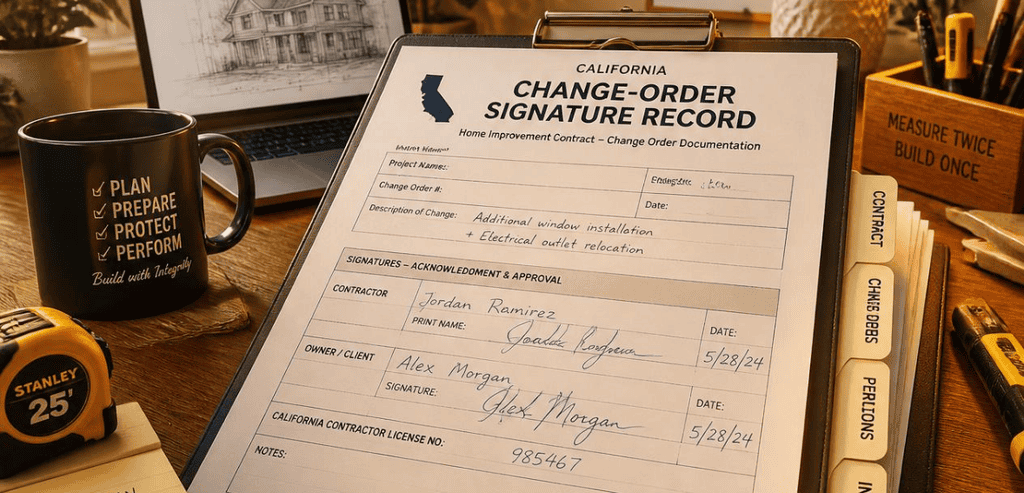
A compliant change order is short, but it cannot skip the essentials. To satisfy the California home improvement change order requirements, each signed order should capture the following details before any of the new work begins:
• A clear description of the scope of the extra work or the change being made.
• The exact dollar amount to be added to or subtracted from the contract price, written in dollars and cents.
• The effect of the change on the schedule of progress payments.
• The date the change order is prepared and signed.
• Signatures of both the homeowner and the contractor.
That is the complete checklist, and it is the only list you need. Everything else in solid change-order management is about process and record-keeping, which we cover below in plain paragraphs. If a change order is missing any of these elements, it may not hold up if a dispute lands in front of the CSLB or a court.
Why Change-Order Signature Records Matter So Much
Signatures are everything. A change order missing signatures from both parties is essentially a memo. In order to be an enforceable contract modification, a change order must be signed, dated, and done prior to the start of work.
Signed change orders protect homeowners from invoice padding. They give homeowners the ability to know what work was approved, the cost, and when payment was made. Anything extra can’t ever be added. If the contractor tries to collect for undocumented work, a change order signed by the homeowner provides a strong defense.
Contractors have an added benefit. A signed change order means the client approved the additional work and the additional cost. Collecting payment for additional work means the contractor has to prove the client approved the work. California law has a slight exception to this. Without a signed change order, a contractor has the ability to collect payment for extra work through an equitable remedy to prevent unjust enrichment. This, however, means the contractor has to take on a lawsuit, which is costly and time-consuming. A signed change order protects the contractor for the additional work and cost.
How Long to Keep Change-Order Signature Records
California does not hand contractors a single tidy retention number for every document, so the smart move is to keep records well past the window in which a claim could arise. Disputes over construction work can surface long after the last nail goes in.
For California residents, it is wise to retain signed contracts and every change order for a minimum of four years after a project is completed. This is due to the four-year statute of limitations for written contract claims. Since the exposure window for latent defects is much longer, many contractors and homeowners retain the entire project file, including signed change-order records, for ten years or longer.
Filing everything in the same spot is advisable. The original contract, every signed change order, receipts for progress payments, lien releases, and the correspondence associated with the file should be in one place. Digital copies that are clearly labeled and backed up are the preferred method. A complete signature record is the best evidence if a complaint is ever filed with the CSLB.
Penalties for Skipping Written, Signed Change Orders
Cutting corners on change orders is a gamble that rarely pays off. The consequences range from lost income to license trouble.
For a contractor, the biggest risk of all is not being compensated. If the homeowner does not pay for the undocumented extras, the contractor has very little legal recourse and may end up getting paid nothing, or far less than the value of the work done. This has the potential to wipe out the profit of an entire project.
In addition to not getting paid, there is regulatory risk. The CSLB is able to issue citations with civil penalties and, depending on the specific violation, the penalties can be steep. Furthermore, the board is able to suspend or revoke a license for serious or repeated violations and a license that has been revoked cannot be reinstated for a minimum of one year. The CSLB documents disciplinary actions in their public license lookup and, therefore, the reputational damage can outlast the penalty.
Homeowners are not without their own means. A disgruntled homeowner is able to file a complaint with the board, initiate a claim on the contractor’s license bond, or file a civil or small claims court action. The complaint with CSLB is generally the first action taken. All of this is far more likely to happen to a contractor who does not keep signed documentation.
Best Practices for Managing Change-Order Signature Records
Good habits make compliance almost automatic. The single most important rule is timing. Prepare and sign every change order before the new work starts, never after. A signature collected weeks later, once tempers are high, is worth much less than one obtained calmly up front.
Use a consistent form for all changes, ideally using the change order form built into your contract. Fill in the scope, price adjustment, and schedule impact every time, even on minor changes. Number the change orders in sequence so nothing gets lost. As required by law, give the homeowner a signed copy immediately.
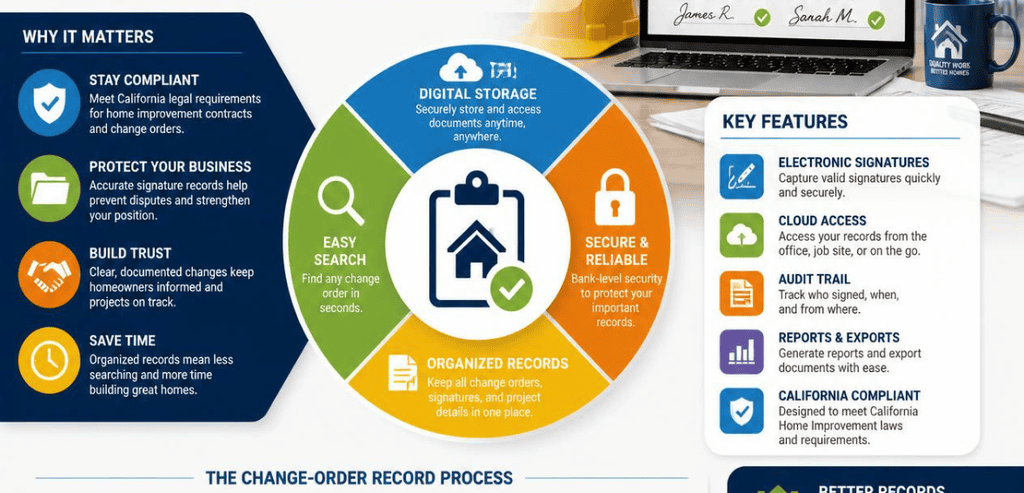
For contractors dealing with multiple projects, a digital solution helps. Construction management software can generate compliant change orders, record legally valid digital signatures, and store time-stamped signed change orders in the cloud. It also simplifies record-keeping. Regardless of the solution you choose, the end goal is the same: signed change orders with a clear, dated paper trail that is ready to be produced on demand.
Conclusion
Change orders are where good projects go sideways and where good record-keeping saves the day. California law is not subtle about it. Extra work and changes must be in writing, must spell out scope, cost, and payment impact, and must be signed by both parties before the new work begins. Get those pieces right and you protect everyone at the table.
For homeowners, insisting on a signed change order every time is the simplest way to avoid surprise bills. For contractors, keeping thorough change-order signature records is both a legal duty and the surest path to getting paid without a fight. Treat the paperwork as part of the craft, not an afterthought, and you will stay on the right side of the California home improvement change order requirements every time.
Frequently Asked Questions (FAQs)
Do Change Orders Have to Be in Writing in California?
Yes. Under California law, extra work and change orders only become part of a home improvement contract once they are prepared in writing and signed by both parties before the covered work begins. A verbal agreement to extra work is not enough to make the change enforceable.
What Must a California Change Order Include to Be Valid?
A valid change order must describe the scope of the extra work or change, state the exact dollar amount added to or subtracted from the contract, and explain how the change affects the schedule of progress payments. It also needs to be dated and signed by both the homeowner and the contractor.
Can a Contractor Charge for Extra Work Without a Signed Change Order?
It is risky and generally not allowed. Contractors cannot force a homeowner to pay for undocumented extras. That said, California law does not completely bar a contractor from recovering a reasonable amount for genuine extra work under equitable principles that prevent unjust enrichment. Relying on that is far weaker than having a signed order.
How Long Should I Keep Home Improvement Change-Order Records?
Keep them for at least four years after the project is finished, which tracks the statute of limitations for written contract claims in California. Because some defects surface much later, many people retain the full signed project file for ten years or more. Store the contract and all change orders together in one secure place.