
Best Housecall Pro Alternatives for Small Contractors Who Want Simpler Operations
Running a small contracting business is challenging, and having software shouldn’t make it any harder. In the early days of contracting, considering an all-in-one business solution software to organize the business may seem like a good option. However, as the business grows, it may become difficult to use, feel overwhelming, or be too expensive to continue using. Small contracting businesses do not require sophisticated marketing or enterprise workflow automation tools; they need business management software to support job scheduling, estimating, invoicing, and job management to be as efficient as possible.
This is the reason why business owners search for Housecall Pro alternatives. Replacing one business software application with another is not the goal; the goal is to find a small contracting business solution that accelerates its workflow. Many businesses have found that the best Housecall Pro alternatives are those that reduce administrative work, speed payment for completed work, and improve communication between administrative staff and technicians.
This guide is intended to show alternative software for contractors that will help simplify operations, with that as the primary goal. Focus will be on ease of use, mobility, scheduling, and invoicing to improve the software’s fit with the business rather than on the number of features. When looking at field service software options for small businesses, this article will help you choose the ones that best match how you work.
Why Small Contractors Start Looking for Housecall Pro Alternatives
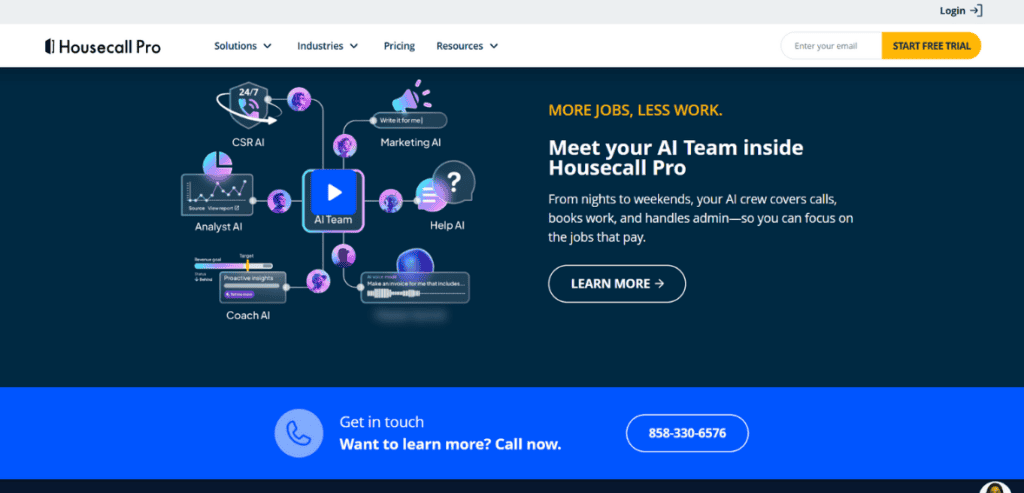
Image source
When it comes to Housecall Pro, most small contractors do not seem to think it is bad software or that it is a problem for them to invest a lot of time learning a new one; rather, they begin to feel a financial burden as they scale. This is what prompts small contractors to conduct industry research on competitors to Housecall Pro. Instead of learning a complex new software timeline, small contractors find value in software that simplifies day-to-day operations, reduces financial burden, and streamlines accounting.
Small contractors feel the burden of software that adds steps, as small contractor owners need to do the job of several people to keep the business running. Many searches for Housecall Pro competitors focus more on usability and cost than on the perceived business value derived from the software. This is most likely to describe the business that serves the contractor most directly, who is most likely to get directly involved in the work. This generally describes Housecall Pro as an enterprise subcontractor software rather than a cost-effective solution, clearing the way for contractors to bypass it.
Cost is one of the biggest driving factors of small companies. Small contractors typically want their software to feel the scale they need to work with, ensuring competitors to Housecall Pro are of similar quality and not outstripping their genuine requirements.
Another typical reason for changing over is workflow requirements. Small contractors often want a very streamlined route from lead to estimate to job to invoice. If the software requires the user to click through many screens, rely on many integrations, or is designed to force them to collaborate in a way that does not parallel the work in the field, the likelihood of software adoption is low. At that point, the software becomes one more thing to manage rather than one thing to take off the manager’s plate.
Finding better contractor software replacements often boils down to one question. Will this software make running the business easier daily?
What Small Contractors Should Look for in a Simpler Platform
Before looking for Housecall Pro alternatives, it’s helpful to understand what “simpler” means in the context of real operations. Simplistic software is not software that has fewer buttons. It’s software that enables a contractor to complete a set of common goals more quickly and with fewer mistakes.
For many small teams, the best small business field service software will have a straightforward time-block view, true mobile tech access, fast estimating, simple invoicing, customer reminders, and payment collection. Additionally, the platform must have low training requirements. If the new office admin or tech doesn’t learn the software’s basic functions quickly, you’ll find it’s a time drain.
Accounting is an important factor, too. Many contractors prefer to integrate their accounting systems with tools like QuickBooks or Xero, as double-entry bookkeeping can become an incredible time sink. Multiple sources comparing competitors to Housecall Pro emphasize the clarity of reporting, the cost per user, and the ability to customize reporting as differentiating factors.
However, the most critical factor is fit. While advanced systems may shine in demos, if your company has only five people and predominantly performs residential service work, then you might be better off with a system designed for speed and the automated execution of repetitive tasks, rather than one that offers a lot of complexity.
Top Housecall Pro Alternatives for Small Contractors
The following platforms are consistently recognized as viable alternatives to Housecall Pro for small service contractor businesses and are well-positioned in the marketplace. Some are better for certain trades, volumes, or stages of growth. Ultimately, the best fit depends on whether you prioritize a low learning curve, better field workflows, flexible pricing, or control over operational processes.
Workever

Image source
Workever is historically one of the strongest competitors to Housecall Pro for small field service teams looking for easy daily operations. Current comparisons to competitors show configurability with less complexity, allowing users to integrate scheduling, quoting, invoicing, and accounting functions without paying additional costs for features they won’t use.
For small contractors, that positioning makes sense. Workever stands apart from the all-purpose operational software and instead focuses on the center of the workflow. This is helpful for plumbing, HVAC, electrical, maintenance, and general service contracting businesses that need a system to book work, assign jobs, track work, and get paid.
Where Workever’s value is strongest is when a company has a clear operational vision and wants to avoid a lot of software. If your team is frustrated with unnecessarily complex systems or growing user costs, Workever is one of the Housecall Pro competitors that deserves your most serious consideration.
Jobber
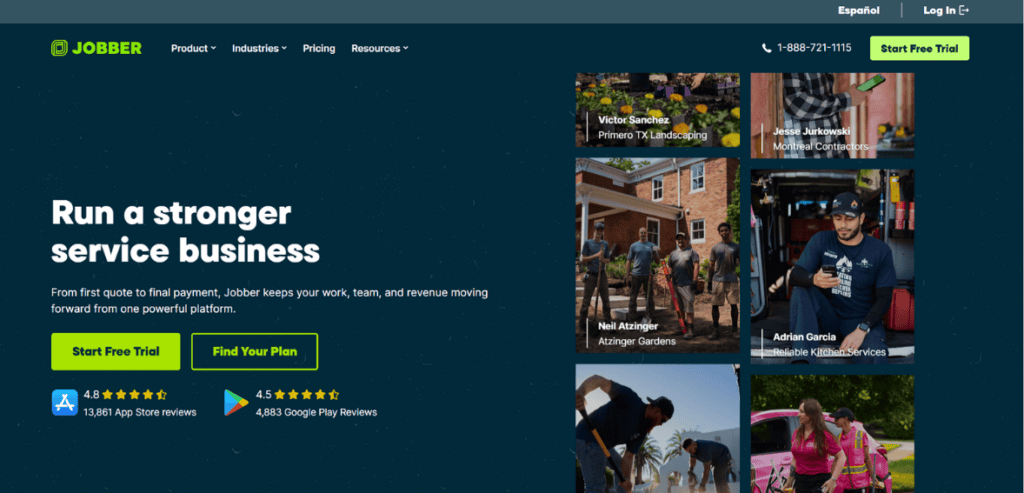
Image Source
Jobber is a highly visible name in the space and is often featured in comparison articles about Housecall Pro competitors. It is regarded as a more polished option for service businesses that need a wide range of features and a straightforward mobile experience. Newer content in comparisons also indicates that it provides growing teams with space to scale, though there can be a downside: costs can increase as a business adds more subscriptions or users.
Jobber’s value proposition for small contractors is primarily its balance, as it typically sits in the middle of the extremes between ultra-bare-bones tools and overly complicated, highly integrated enterprise products. This makes it a viable proposition for businesses that want software that is still approachable yet can handle the increased operational load over time.
Jobber can be a viable option for your business if you need a consistent user experience and a good combination of scheduling, customer management, quoting, and invoicing in one place. It may not be the most cost-effective option for every team, but it is a go-to for business owners who want neat, optimized workflows and the potential for growth.
ServiceM8
ServiceM8 is often cited as a good option for small service businesses, especially those seeking a direct, mobile-centric approach. Numerous comparative reviews mention its ease of use, proof-of-work features, and integrations with accounting as reasons contractors consider it when evaluating contractor software options.
For most small contractors, ServiceM8 provides an easy-to-use contractor software option to help them get through their workday as smoothly as possible. Many contractors feel the platform is designed for job management, on-site updates, and keeping work flowing, rather than offering a large set of features. Because of this, it is a good fit for businesses that want to keep their team members focused on getting work done in the field and do not want a complicated back-end software system.
It is especially appealing when the level of work is consistent, the business needs a contractor’s software designed to keep technicians working, and there is little office work required. In the field service software for small businesses, this is a significant advantage.
Tradify
Image Source
Tradify is another alternative to Housecall Pro, popular among trade businesses that need simple quoting, job tracking, and invoicing. In industry comparisons, it is often considered a reasonable option for contractors seeking a simple, consistent workflow and solid accounting integrations.
Its strength is its simplicity and ease of use. For small contractors, Tradify offers an appealing option that simplifies their everyday trade work, rather than having to sift through a complicated set of features. This often results in a simpler implementation and a higher chance of team buy-in.
Tradify is particularly suitable for companies that deal with a lengthy process of transitioning from estimates to active jobs and invoicing. It is especially suitable for teams seeking structure and simplicity, and looking for alternatives to Housecall Pro that are more straightforward.
Fieldy
Fieldy is being talked about more as an alternative to Housecall Pro. It is marketed as a more straightforward, cost-effective solution for contractors seeking essential field service capabilities without the added overhead that larger systems can introduce. Fieldy highlights scheduling and dispatching, invoicing, customer management, and mobile as reasons to switch.
This is especially true for small contractors. If the main priorities are office organization, field team alignment, and simplified billing, then a streamlined solution is likely more effective than a more comprehensive system loaded with additional capabilities. Fieldy is intended for contractors seeking that streamlined approach.
As a Housecall Pro alternative, it likely attracts cost-conscious firms, especially those that are scaling slowly due to frustration with paying for underutilized features. This aligns with a growing preference among small business owners for more straightforward field service software.
BuildOps
BuildOps is often talked about in the broader alternative space, but it appears to be focused on a more advanced segment of the market. In descriptions that compare, it is usually described as offering greater operational control, deeper dispatching, and support for more complex service environments. So, it is still worth mentioning, even if it likely won’t be the best fit for small contractors.
BuildOps may feel like more platform than needed for very small teams. But for contractors on the verge of outgrowing lightweight systems and looking for greater visibility into jobs, teams, and operations, it can become a serious contender. This is a good example of why the best Housecall Pro competitor depends on your current size and where you foresee the business moving in the near future.
If your company is still focused on operational, keeping things lean, other contractor software alternatives may feel like a more organic fit. However, if you are experiencing increasing levels of complexity, BuildOps may initially be just what you need, but the need for more structure will increase.
Which Type of Alternative Fits Your Business Best
Not all contractors leaving Housecall Pro are doing it for the same reason. A solo operator or two-person shop is likely to need a scheduling, estimating, and invoicing solution that is simple and requires minimal configuration. A more developed service company with a dispatcher and multiple technicians will likely require more automated, route visibility, and superior reporting. A contractor taking on more complicated work will likely need more advanced job tracking and operational oversight.
Each of Housecall Pro’s competitors does its marketing differently. Some competitors prioritize user simplicity over everything else. Some competitors value long-term business growth over everything else. Some competitors prioritize a low level of effort for users over everything else. Some competitors prioritize user control over everything else. This means that, for the work you do today, you’ll want to prepare for how it may evolve over the next three years. This means that for the work you do today the most important part of your work is to align this to your business model that you may have three years from now.
Field service software designed for small businesses creates value quickly by occupying the sweet spot of low-end, mobile-friendly, easy-to-train software for core workflows in the field, combined with simplified operations.
How to Choose Without Overbuying
Small contractors’ biggest software mistake is overpurchasing. Software is more than just data hitched to a user interface; a solid business model is more than just a polished demo. Each of the many features feels valuable during a shiny demo. The true value of a feature is in the workflows it enables. Often, a simplified workflow within a business creates faster onboarding, increases user adoption, and reduces administrative burden. Sadly, it is this simplicity that is most often overlooked.
Therefore, it is best to use competitors to Housecall Pro to approximate your business model as closely as possible. This closely aligns with the type of business effort you will undertake and the result-driven workflow.
Considering the next year or two will also be important, and not just the next twelve days. The best contractor software options offer flexibility and the ability to grow without paying for the expensive options too soon. It is important to entice a new customer without sending them too many options. Balance is important to some degree; too much will make the software overly complicated.
Conclusion
The top alternatives for Housecall Pro for small contractors are those that simplify operations. Faster scheduling, clearer communication, quicker invoicing, reduced time spent on software management, and overall reduced effort. Simple is not a compromise.
Workever, Jobber, ServiceM8, Tradify, and BuildOps are the right alternatives, depending on whether your business needs a lighter workflow.
If you are looking at contractor software alternatives, the best choice is the one that makes your day easy. That’s the simple choice. The best field service software is the one that the team enjoys.
Frequently Asked Questions
Which Services Are Considered the Best Alternatives to Housecall Pro for Small Contractors?
The most frequently mentioned Housecall Pro alternatives for small contractors are Workever, Jobber, ServiceM8, Tradify, Fieldy, and BuildOps. Ultimately, the best option depends on whether you are looking for less complexity, better mobile workflow, more advanced invoicing, or more scalability.
What Do You Think Are the Most Important Aspects for Housecall Pro Competitors to Focus On?
A good Housecall Pro competitor will streamline central processes more than others. Think in terms of less time to create a work schedule, improved invoicing workflow, easier estimate processes, mobile staff access, and reasonable pricing for small teams. Training time can take longer than expected as well.
Are There Contractor Software Alternatives That Are Better for Very Small Teams?
Yes. Some contractor software alternatives are designed for smaller service businesses and emphasize speed, clarity, and low software overhead costs. These are often more appropriate for small contractor formations than designs for large or overly complex systems.
How Should Small Businesses Go About Choosing Field Service Software?
Start with the workflow as you do it. Consider how your team books, estimates, dispatches, processes payments, and conducts follow-up. The most effective field service software for small businesses will minimize the steps and clear the clutter around the actions you do most often.